Texas Explained
The Rio Grande Explained: Texas' International River and Largest Basin
The Rio Grande crosses states, deserts and an international boundary before reaching the Gulf. In Texas, its enormous basin, low watershed yield and compact-and-treaty rules make it a river unlike any other in the state.
The Rio Grande is both a river and a boundary, which makes it fundamentally different from the other major rivers Texas manages entirely within the state. Its water begins far upstream, crosses multiple jurisdictions and eventually forms the international boundary between Texas and Mexico from El Paso to the Gulf of Mexico.
The largest basin footprint in Texas
TWDB identifies the Rio Grande Basin as covering the largest area in Texas of any major river basin. The full river begins in Colorado, flows through New Mexico and later receives the Rio Conchos from Mexico before continuing along the Texas-Mexico border.
Within the Texas portion of the basin, important tributaries include the Pecos and Devils rivers, along with Alamito, Mud and Pinto creeks and the Arroyo Colorado. Those tributaries connect mountain, desert, spring-fed and agricultural landscapes to the same international river system.
A huge basin can still have a low water yield
The basin's scale can be misleading. TWDB describes its average annual watershed yield as extremely low because so much of the watershed lies in arid or semiarid climate. Like the Texas Colorado, the Rio Grande shows why drainage area and reliable water supply are not the same thing.
Water allocation crosses state and national borders
TWDB notes that surface water in the basin is governed by multiple agreements, including the Pecos River Compact, the Rio Grande Compact, the 1906 Convention and the 1944 water treaty between the United States and Mexico. That means the Texas portion of the river cannot be managed as though all of the water originates or is allocated inside Texas.
For readers used to county, city or even state water systems, this is the key difference: upstream decisions, interstate obligations and international agreements are built into the basin's operating reality.
Major reservoirs store water in a dry landscape
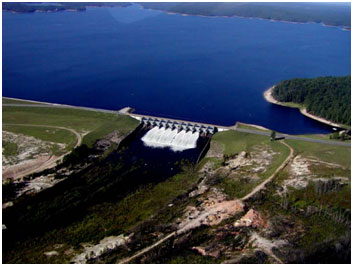
TWDB lists Amistad International Reservoir and Falcon International Reservoir among the major reservoirs of the basin, along with Red Bluff and others. Large reservoirs are especially important in a system where runoff is limited and water must be stored across highly variable conditions.
The river is not one landscape
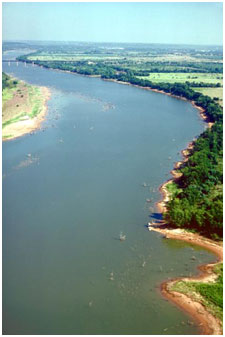
Near El Paso, the river belongs to a desert border landscape. Farther downstream it passes through the Big Bend region, receives tributaries such as the Pecos and Devils, and eventually reaches irrigated lower-valley country before the Gulf. Treating the Rio Grande as a single visual type hides how much Texas geography it connects.
What the Rio Grande teaches
- The largest watershed area does not guarantee a high average water yield.
- Texas can depend on river water whose headwaters and governing agreements lie outside the state.
- International and interstate allocation are part of the river's basic water-management structure.
- Reservoir storage is crucial in an arid and highly variable basin.
- One river can connect desert, canyon, agricultural and coastal landscapes over an enormous distance.
A river that makes Texas part of a larger water system
Most Texas river guides can begin and end with the state map. The Rio Grande cannot. To understand it, you have to look upstream into Colorado and New Mexico, across the border into Mexico and downstream toward the Gulf. That larger frame is exactly what makes the Rio Grande so important to understanding Texas: it is a reminder that water ignores the political boundaries people draw around it.
Primary source: Texas Water Development Board ↗
Filed under
- Rio Grande
- Rio Grande basin
- Texas Mexico border
- Amistad Reservoir
- Texas water
- TWDB
From the magazine
More stories to read next
Lakes & Rivers
Toledo Bend Explained: Texas' Largest Reservoir and a Two-State Water Project
August 16, 2026 · About 9 minutes
Lakes & Rivers
Possum Kingdom Lake Explained: An Early Brazos River Multipurpose Reservoir
August 16, 2026 · About 9 minutes
Lakes & Rivers
Lake Whitney Explained: A Brazos River Reservoir Built for Multiple Jobs
August 16, 2026 · About 9 minutes