moving to texas
Texas Culture for Newcomers: The Social Customs, Traditions and Habits You Notice First
Y'all, brisket by the pound, boots with a suit, Friday-night football and a flag on almost everything: a practical guide to the everyday customs that make Texas feel different.
Texas culture is easiest to understand as a collection of habits rather than a costume. You do not need boots, a ranch or a drawl to belong here. What newcomers tend to notice first are small repeated signals: people using y'all without thinking about it, strangers acknowledging one another, school colors taking over a town on Friday, a Texas flag flying beside the U.S. flag, and a barbecue line where the person at the counter asks how many pounds you want.
The state is far too large and diverse for one personality. Houston, El Paso, Amarillo, Brownsville and Fredericksburg do not behave like copies of one another. Still, some traditions travel remarkably well across regions. This guide is about those everyday patterns—and about where the stereotype needs a little correction.
Barbecue is ordered like a market purchase
At many traditional and craft barbecue counters, brisket, sausage, ribs and other meats are sold by weight or by the piece. The butcher-paper tray is part of the experience: order the meat first, move to sides, add pickles, onions, bread and sauce, then find a table. A quarter-pound is a tasting portion; a half-pound can be a substantial serving depending on what else is on the tray.
That counter ritual is important enough that TexasDefined has a separate beginner's guide. The useful cultural point is simple: a barbecue counter is closer to an old meat market than a conventional sit-down restaurant, and that history still shapes how the meal is sold.
State pride is unusually visible
Texans put the state outline, Lone Star and flag on homes, businesses, clothing, trucks, menus and public buildings. The flag often appears beside the U.S. flag rather than in place of it. State pride is not universal or politically uniform, but it is unusually visible in ordinary commercial and civic life.
'Don't Mess with Texas' is a good example of a message that became larger than its original purpose. It began as an anti-litter campaign, then escaped into the culture as a slogan of state attitude. The original meaning still matters: it is not an official declaration of toughness; it is a litter-prevention brand that Texans adopted as shorthand.
Y'all works because it is useful
'Y'all' is the everyday second-person plural for millions of Texans. It can address two people or a roomful. 'All y'all' adds emphasis or makes clear that the speaker means the entire group. Calling it the state's 'official pronoun' is a joke, not a legal designation, but the word is so functional that newcomers often adopt it quickly.
Sir and ma'am remain common courtesy in many families, schools, workplaces and service interactions, especially when speaking to an older person or someone in authority. Usage varies by age, region and community, so the safest rule is to read the room rather than perform a caricature of Texas manners.
The friendly nod is real, but Texas is still a big urban state
In smaller towns, suburban neighborhoods and less hurried settings, eye contact, a nod, a wave or a quick hello between strangers is ordinary. That does not mean every grocery aisle in Houston or Dallas turns into a conversation. Texas friendliness is best understood as a lower barrier to casual acknowledgment, especially once people are standing still long enough to talk.
Neighborliness becomes especially visible during storms, freezes and power outages. People share information, check on older neighbors, lend tools and move fallen limbs. That behavior exists everywhere, but severe weather gives Texas neighborhoods recurring reasons to practice it.
Football is a social calendar as much as a sport
High-school football can function as a weekly civic gathering, particularly in smaller communities and football-heavy suburbs. Stadiums, marching bands, drill teams, cheer, booster clubs and student media turn game night into a much larger school event. The scale can surprise newcomers because some districts invest in facilities designed for crowds that would look at home in lower-level college sports.
College allegiance has a similar social reach. Texas and Texas A&M are the most visible statewide rivalry, but Texas Tech, Baylor, TCU, Houston, SMU and other programs have deeply committed followings. In football season, school colors can tell you a surprising amount about the weekend plans in a household.
Boots are not reserved for ranch work
Cowboy boots occupy an unusual place in Texas dress because they can move between practical, casual and formal settings. A good pair may show up with jeans at work, a suit at a wedding or a dress at a formal event. That versatility is more culturally accurate than the idea that everyone wears a cowboy hat every day.
The broader Texas dress code is usually climate-aware. Shorts, breathable shirts and sandals are common in warm months, while workplaces and formal venues still set their own standards. Heat encourages practicality, not the absence of dress codes.
Two-step, dance halls and Texas country music still connect generations
Historic dance halls and modern honky-tonks keep the two-step visible as a real social skill rather than a tourist performance. Some people grow up learning it; others learn after moving here. Either way, the dance gives Texas music a participatory culture that is different from simply attending a concert.
Texas Country and Red Dirt are overlapping scenes with roots in honky-tonk, singer-songwriter and regional touring culture. Austin is famous for live music, while Houston, Dallas–Fort Worth, San Antonio, Lubbock and other cities have produced major country, blues, Tejano, hip-hop, rock and conjunto traditions. There is no single 'Texas sound.'
Homecoming mums really are that big
Texas homecoming mums began with chrysanthemums and evolved into elaborate wearable displays made from ribbons, bells, braids, school colors, names, lights and sometimes stuffed animals. The scale can look unbelievable to someone from another state, but the tradition is a normal part of homecoming season in many Texas high schools.
The State Fair, rodeos and Fiesta turn civic identity into events
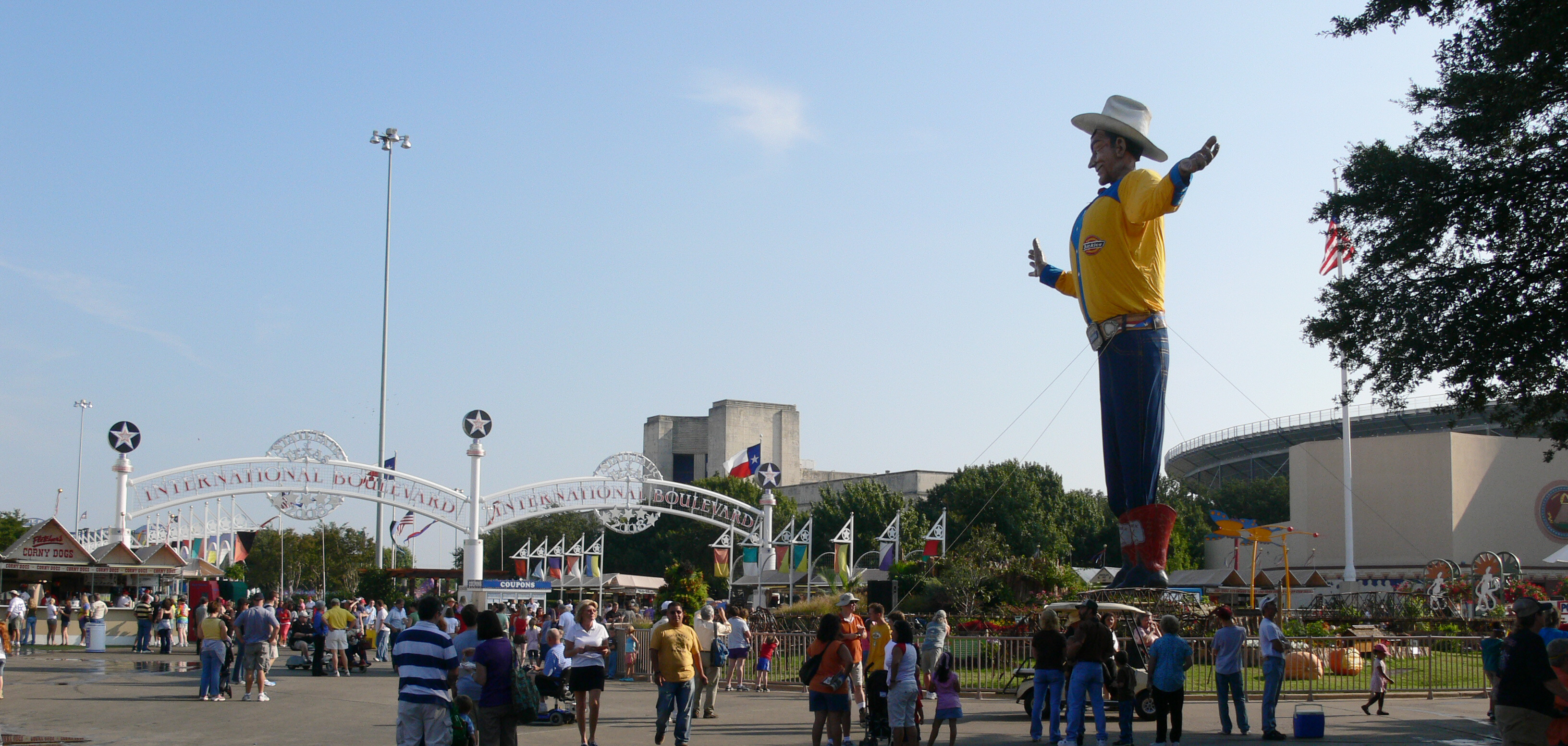
The State Fair of Texas in Dallas, with Big Tex and a culture of inventive fried food, is one of the state's most recognizable annual traditions. Rodeos combine livestock competition, youth agriculture, concerts, food and commercial exhibitions; the Houston Livestock Show and Rodeo is the best-known example of that large modern format.
Fiesta San Antonio is another reminder that Texas identity is not one cultural stream. Parades, medals, food and neighborhood events reflect the city's Mexican, Tejano, military and civic history. The same is true of Juneteenth: the national holiday's Texas roots lead back to Galveston and June 19, 1865, making the date both national history and a specifically Texas story.
East Texas can feel Southern; West Texas can feel Western
A useful newcomer shortcut is that the cultural map changes with the physical one. The Piney Woods share foodways, vegetation and historical ties with the Deep South. The Panhandle and West Texas carry stronger ranching, High Plains and Western identities. South Texas and the Rio Grande Valley are deeply shaped by Mexican and Tejano history. Central Texas layers German and Czech settlement onto older Mexican, Indigenous and Anglo histories.
These are tendencies, not boxes. Modern Texas cities are diverse enough that multiple regional and international cultures coexist block by block.
'Everything is bigger' is partly joke, partly planning reality
The phrase survives because scale really does show up in Texas: wide highways, enormous master-planned communities, giant high-school campuses, sprawling metropolitan areas and restaurants built around large portions. But bigger is not automatically better, and the useful lesson for newcomers is logistical. Distances that look close on a map can still mean long drives, and a 'nearby' suburb may operate like its own city.
'Bless your heart' depends entirely on tone
The phrase can express sympathy, affection, exasperation or criticism. Treating it as automatically passive-aggressive misses how ordinary language works. Context, relationship and tone decide whether it is kind, cutting or simply habitual.
You do not have to be born here to participate
Texas has absorbed generations of domestic and international migration. New residents bring languages, food, businesses, music and traditions that become part of the state rather than sitting outside it. The most durable version of Texas identity has always been additive: people arrive, adapt to local habits and change the place at the same time.
Image credit: Andreas Praefcke · CC BY 3.0 · Wikimedia Commons
Primary source: TexasDefined culture desk ↗
Filed under
- texas culture
- moving to texas
- texas customs
- texas traditions
- yall
- texas pride
- texas etiquette
- texas identity
From the magazine
More stories to read next
Moving Here
Texas vs. Florida: The Relocation Tradeoffs That Actually Matter
August 20, 2026 · About 17 minutes
Moving Here
Texas vs. California: What Changes When You Actually Move
August 20, 2026 · About 17 minutes
Moving Here
Texas Cities and Regions: How Houston, DFW, Austin, San Antonio and the Rest Really Differ
August 19, 2026 · About 8 minutes