
texas history
Why San Antonio Became a Military Aviation Capital
Kelly Field, Brooks Field, Randolph, Lackland and Fort Sam Houston turned San Antonio into one of the most important military training and aviation centers in the United States.
San Antonio's military identity is older than aviation, but aviation changed the scale of that identity. By the early twentieth century the city already had Fort Sam Houston, a major Army post with transportation links, training space and a large military population. When powered flight became militarily useful, San Antonio had the land, weather, infrastructure and institutional support to become one of the country's most important aviation centers.
The result was not one famous airfield but a network. Kelly Field, Brooks Field, Randolph Field and the installation that became Lackland each took on different roles in flying, maintenance, medicine, instruction and basic military training. Their missions changed over time, but together they helped define San Antonio as Military City USA long before that phrase became a civic brand.
Fort Sam Houston created the military foundation
The Army established a permanent presence in San Antonio during the nineteenth century, and Fort Sam Houston grew into a major headquarters, supply and medical center. That mattered when aviation arrived because early military flight did not operate independently. Aircraft, pilots, mechanics, medical staff, supply units and command structures all depended on the larger Army system already present in the city.
San Antonio's relatively mild winters and large areas of open land also made year-round training practical. Those conditions became increasingly valuable as the Army experimented with aircraft and needed places where student pilots could fly frequently.
Kelly Field opens as the United States enters World War I
Kelly Field began operations in 1917 only days before the United States entered World War I. It quickly became one of the largest aviation training centers in the country, preparing pilots and support personnel for a rapidly expanding air arm. The installation was named for George E. M. Kelly, an Army aviator killed in a crash at Fort Sam Houston in 1911.
World War I aviation required far more than pilots. Engines, airframes, instruments, photography, communications and logistics all demanded specialized training and maintenance. Kelly's growth created a military-industrial workforce inside San Antonio and tied aviation directly to the city's economy.
Brooks Field adds training and aviation medicine
Brooks Field was established during the same wartime expansion. It became an important flying and medical center, especially as the military began studying how altitude, fatigue, oxygen, vision and other physiological factors affected aviators. The School of Aviation Medicine became one of the institutions that linked San Antonio to the scientific side of military flight.
That work helped make the city more than a place where aircraft took off and landed. San Antonio became part of the system that defined how pilots were selected, trained, medically evaluated and kept fit to fly.
The problem in the 1920s: Kelly and Brooks were running out of room
As military aviation professionalized after World War I, the Army Air Corps needed a more orderly training system. Kelly and Brooks had grown around wartime demands and lacked enough room for the ground schools, housing and standardized training facilities the Air Corps wanted.
General Frank Lahm, responsible for flying training, established the Air Corps Training Center at Duncan Field beside Kelly. The need for a purpose-built training base soon became clear, setting the stage for one of the most ambitious military planning projects in Texas.
Randolph Field: the West Point of the Air
Randolph Field was planned in the late 1920s and dedicated on June 20, 1930. Its circular layout, monumental administration building and coordinated airfield design reflected an effort to create a permanent center for aviation education rather than another improvised wartime base.
Flying training began in 1931. Randolph became widely known as the West Point of the Air because of its role in producing and instructing military aviators. The base also absorbed functions from Kelly and Brooks as the Air Corps reorganized training around a more specialized sequence.
World War II turns San Antonio into a training machine
The scale of military aviation expanded dramatically during World War II. Texas hosted dozens of airfields because open land and favorable weather allowed intensive training. San Antonio became a central node in that network, with Kelly, Randolph, Brooks and nearby facilities handling instruction, maintenance, medical work, logistics and personnel processing.
Randolph's mission shifted toward instructor training and later B-29 transition training. Kelly became a major maintenance and logistics complex. The demand for personnel also created a new installation west of the city that would become one of the most recognizable names in Air Force training.
Lackland grows from the San Antonio Aviation Cadet Center
Construction began in 1941 on land that was initially part of Kelly Field. The site became the San Antonio Aviation Cadet Center in 1942 and was later renamed Lackland Air Force Base. As the independent U.S. Air Force took shape after 1947, Lackland became the service's major basic military training installation.
That role gave San Antonio an unusual place in American military life. Generations of Air Force recruits passed through Lackland before moving to technical schools and operational units around the world. For many service members, San Antonio was their first sustained experience of military culture.
The independent Air Force changes names, not the city's importance
The U.S. Air Force became a separate military service on September 18, 1947. Randolph Field became Randolph Air Force Base in 1948. Kelly and Lackland also evolved under the new service while Fort Sam Houston remained an Army installation. Brooks continued to connect aviation, medicine and research.
The Cold War kept the region strategically important. Pilot training, instructor training, logistics, depot maintenance, medical research and basic training created a military ecosystem larger than any single base.
Kelly's closure did not erase its aviation legacy
Kelly Air Force Base closed in 2001 as part of the Base Realignment and Closure process, ending a famous chapter in San Antonio aviation history. Much of the property transitioned into what is now Port San Antonio, where aerospace, logistics and technology work continue on land shaped by decades of military use.
The closure illustrates a broader pattern in military cities: bases can change mission, name or ownership while their roads, hangars, neighborhoods and labor force continue influencing urban development long afterward.
Joint Base San Antonio connects the surviving installations
Today Fort Sam Houston, Lackland and Randolph operate as major components of Joint Base San Antonio. The joint-base structure reflects a modern effort to consolidate support functions while preserving distinct missions. San Antonio still hosts military medicine, basic training, flying training, personnel functions and a large population of active-duty members, reservists, civilians, retirees and military families.
- Fort Sam Houston: Army command, medical and training history with roots in the nineteenth century.
- Kelly Field: aviation training and logistics beginning in 1917; later a major Air Force maintenance complex.
- Brooks Field: flying, aviation medicine and aerospace medical research.
- Randolph: purpose-built Air Corps training center dedicated in 1930 and still central to flying training.
- Lackland: wartime personnel center that became the best-known gateway to Air Force basic military training.
How to read the aviation landscape today
Much of this history is embedded in working military property rather than a single museum district. Historic hangars, administrative buildings and airfield layouts survive in different forms, but access varies because many locations remain active installations. The best public approach is to use official base history resources, historic photographs and accessible museums to understand how the network evolved.
Archival photographs are especially valuable here. Library of Congress images from Kelly Field, military photo collections, base newspapers and digitized training publications make it possible to see San Antonio's aviation transformation without relying on generic aircraft imagery.
Why San Antonio mattered so much
San Antonio succeeded as an aviation center because several advantages reinforced one another: existing military infrastructure, open land, flying weather, rail and road access, a growing technical workforce and decades of institutional momentum. Once training, maintenance and medical expertise concentrated there, each new mission made the next one easier to place in the region.
That is why the city's military aviation history is not a list of bases. It is the story of a network that helped turn experimental flight into a permanent military profession—and made San Antonio one of the enduring centers of American airpower.
Image credit: National Photo Company Collection / Library of Congress · 1917 · No known restrictions · Wikimedia Commons
Primary source: Joint Base San Antonio ↗
Filed under
- san antonio military history
- kelly field
- randolph field
- lackland air force base
- brooks field
- military aviation
- joint base san antonio
- texas aviation history
Plan the trip
Places connected to this story
Destinations explicitly tied to this article in the Texas Defined guide.
San Antonio · Bexar County
The Alamo
San Antonio's best-known historic landmark: the former Mission San Antonio de Valero, where more than three centuries of mission, military, revolutionary and preservation history converge in the heart of downtown.
Best season: Fall through spring for comfortable downtown walking; in summer, visit near opening for cooler temperatures and lighter crowdsUpdated Aug 2026- Historic Alamo Church and Long Barrack
- Alamo Exhibit and the Ralston Family Collections Center
- Living History demonstrations and interpretation of the mission and 1836 battle
San Antonio · Bexar County
San Antonio Missions National Historical Park
Four Spanish colonial mission communities south of downtown San Antonio—Concepción, San José, San Juan and Espada—preserved along the San Antonio River as living parish, architectural and cultural landscapes connected to the city's UNESCO World Heritage story.
Best season: Fall through spring for comfortable walking and biking; summer visits are best early in the day with shade and water built into the routeUpdated Aug 2026- Mission San José and the park's main visitor center
- Mission Concepción's preserved church and stone architecture
- Mission San Juan and the agricultural landscape
San Antonio · Bexar County
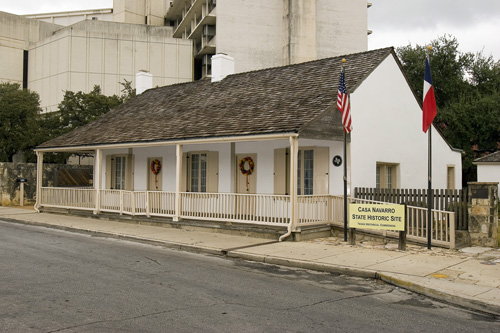
Casa Navarro State Historic Site
The restored home and property interpret the life of José Antonio Navarro, a Tejano statesman, signer of the Texas Declaration of Independence and influential early Texas leader. Casa Navarro adds an indispensable Tejano perspective to a San Antonio history itinerary that can otherwise lean too heavily on military sites alone.
Best season: Year-round; spring and fall are usually the most comfortable for outdoor portions of a visit.Updated Aug 2026- Tejano history
- José Antonio Navarro
- San Antonio
.jpg%3Fwidth%3D1600)

From the magazine
More stories to read next
Then & Now
Texas National Cemeteries: Fort Sam Houston, Houston and Dallas–Fort Worth
August 21, 2026 · About 12 minutes
Then & Now
Texas Military Museums & Historic Sites: The Best Places to See the Story in Person
August 20, 2026 · About 19 minutes

.jpg%3Fwidth%3D1600)