
texas history
Texas National Guard History: From Militia Companies to the Modern Guard
Texas citizen-soldier traditions stretch from colonial-era militia and the Republic through Camp Mabry, the 36th Infantry Division, border mobilizations, world wars, disaster response and post-9/11 deployments.
The Texas National Guard is modern in organization but old in ancestry. Its story reaches back through volunteer companies, frontier militia, the Republic of Texas, state military units after annexation and the federal reforms that created the National Guard system Americans recognize today.
That long history matters because Texas military service has repeatedly moved between two roles. In one role, soldiers and airmen serve under state authority for emergencies inside Texas. In the other, Guard units enter federal service for national wars and overseas deployments. The tension—and flexibility—between those missions is one of the defining features of the Guard.
Before the National Guard name: militia and volunteer companies
Spanish and Mexican Texas relied on local militia systems, while Anglo-American colonies also organized armed companies for local defense. During the Texas Revolution, volunteers, militia companies and a developing regular army operated side by side. After independence, the Republic maintained military institutions while continuing to depend heavily on citizen-soldiers.
The Texas Rangers emerged from the same broader environment of locally organized armed service, although the Rangers followed a different institutional path. Militia, Rangers, regular troops and volunteer companies often overlapped in frontier duties, making neat modern categories difficult to apply to nineteenth-century Texas.
Statehood did not end the militia tradition
After annexation, Texas retained militia authority while U.S. Army troops assumed a larger role in defending the frontier. State volunteers served during the U.S.–Mexican War and later conflicts. During the Civil War, Texas organized forces for Confederate service while also maintaining state military structures for local defense.
Reconstruction disrupted and reorganized state military institutions. By the late nineteenth century, Texas volunteer guard units were becoming more standardized, with drill, uniforms, armories and state-level administration that increasingly resembled a professional reserve force rather than an ad hoc emergency militia.
Camp Mabry becomes the institutional home
Camp Mabry in Austin became central to that transformation. The state acquired land for a permanent encampment in the 1890s, and the post grew into the headquarters and training center of Texas military forces. Its location near the capital made it both an operational installation and a visible symbol of the state's organized militia tradition.
Today Camp Mabry remains headquarters for the Texas Military Department and houses the Texas Military Forces Museum. The museum is especially valuable because it interprets the entire institutional arc—from early militia and Republic forces through the National Guard, State Guard and modern missions—rather than focusing on a single war.
The 1903 Militia Act creates the modern National Guard framework
The Militia Act of 1903, often called the Dick Act, transformed state militias nationwide by tying federal funding to training, organization and equipment standards. Texas units became part of a more integrated reserve system that could be mobilized for federal service while remaining under state control when not federalized.
That dual status became increasingly important as the United States entered a period of overseas war and border instability. Guard units were no longer only local defense organizations; they were becoming part of national military planning.
1916: the Mexican border mobilization
The border crisis of 1916 provided a major test. After Pancho Villa's raid on Columbus, New Mexico, National Guard units from across the country were mobilized along the Mexican border. Texas Guard units served in patrol, security and training roles while General John J. Pershing led the Punitive Expedition into Mexico.
The mobilization exposed thousands of citizen-soldiers to large-unit logistics, field sanitation, communications and extended active duty. That experience proved immediately relevant when the United States entered World War I the following year.
World War I and the 36th Division
Texas and Oklahoma National Guard units helped form the 36th Division, later known as the 36th Infantry Division or the T-Patch Division. The division trained at Camp Bowie in Fort Worth before deploying to France. Its wartime service established one of the most durable unit identities in Texas military history.
World War I also accelerated the federalization of Guard training and command. Citizen-soldiers who had once drilled locally were now serving inside a national army built for industrial warfare overseas.
World War II: federalization leaves a state-defense gap
The Texas National Guard entered federal service before the United States formally joined World War II. The 36th Infantry Division was mobilized in 1940 and later fought in North Africa, Italy, France and Germany. The division suffered heavy casualties and became closely associated with Texas wartime memory.
Federalization created a practical problem at home: when Guard units left the state, who would handle state military emergencies? Congress authorized state defense forces, and Texas organized the Texas Defense Guard in 1941. That organization evolved into today's Texas State Guard, which remains a separate state military force from the Army and Air National Guard.
After 1945: a permanent reserve force in the Cold War
The postwar Guard became a standing component of national defense. Texas Army and Air National Guard units trained for Cold War missions while also remaining available to governors for disasters and civil emergencies. Aviation became especially important as Air National Guard units integrated jet aircraft, airlift and other missions into the state's military structure.
The Guard's domestic mission also became more visible. Hurricanes, floods, tornadoes, wildfires, winter storms and other emergencies repeatedly brought Guard personnel into public view as transportation, engineering, medical, aviation and logistics assets were used to support civil authorities.
Post-9/11 service blurred the line between reserve and active force
After September 11, 2001, Texas National Guard units deployed repeatedly in support of operations overseas while continuing homeland missions. Texas Military Department records describe tens of thousands of Texas Army and Air National Guard members serving during the long post-9/11 period.
For many Guard families, the modern experience therefore looks very different from the older stereotype of occasional weekend drills. Repeated mobilizations, long deployments and specialized missions have made the Guard an operational reserve that regularly moves between state and federal responsibilities.
What the Texas Military Department includes today
The Texas Military Department oversees the Texas Army National Guard, Texas Air National Guard and Texas State Guard under the state's adjutant general. The first two can move into federal service; the State Guard remains a state force. Understanding those distinctions prevents a common mistake of treating every uniformed state military organization as the same thing.
- Texas Army National Guard: state-controlled unless federalized; organized as part of the U.S. Army National Guard system.
- Texas Air National Guard: state-controlled unless federalized; organized as part of the U.S. Air National Guard system.
- Texas State Guard: a state defense force that serves under Texas authority and is not a federal military reserve component.
- Texas Military Department: the state agency that provides command and administrative structure for all three components.
Where to learn the history in person
The Texas Military Forces Museum at Camp Mabry is the best single place to understand this institutional history. Its collections cover uniforms, vehicles, weapons, flags, unit histories and the changing role of Texas military forces. Because Camp Mabry remains an active installation, adult visitors should check current entry and identification requirements before arriving.
The larger story continues across the state. Camp Bowie connects the Guard to World War I and later training. Forts and battlefields explain the military traditions that predate the Guard. World War II museums connect Guard units to global war. Modern disaster-response history can be read in Texas communities where citizen-soldiers repeatedly shifted from military training to public service.
Why the Guard is a useful way to read Texas history
The National Guard sits at the intersection of state identity and federal power. It is local enough to respond to a flooded Texas town and national enough to deploy overseas. Its history therefore mirrors a larger Texas pattern: strong state institutions operating inside an increasingly integrated national system.
Following that history from militia companies to Camp Mabry makes the evolution visible. The uniforms, missions and legal structures changed dramatically, but the central citizen-soldier idea remained remarkably durable.
Image credit: Staff Sgt. Timothy Pruitt / Texas Military Department · Public domain · Wikimedia Commons
Primary source: Texas Military Department ↗
Filed under
- texas national guard
- camp mabry
- 36th infantry division
- texas military department
- texas state guard
- texas military history
- citizen soldiers
Plan the trip
Places connected to this story
Destinations explicitly tied to this article in the Texas Defined guide.
Albany · Shackelford County
Fort Griffin State Historic Site
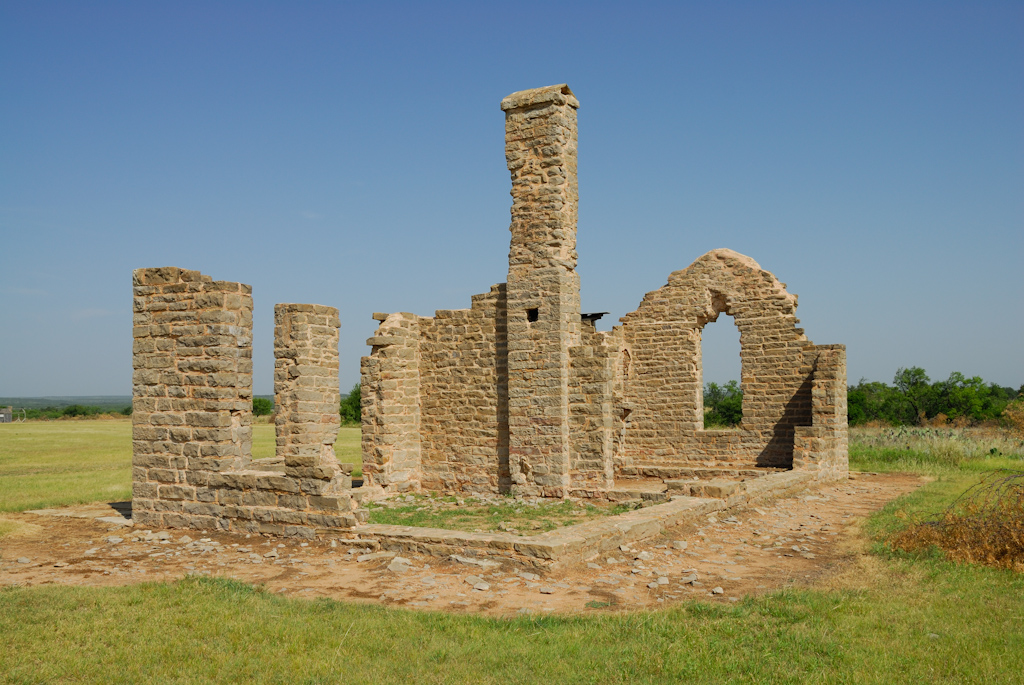
Fort Griffin operated from 1867 to 1881 as part of the U.S. Army's network of frontier posts on the Southern Plains. Ruins, military history and the surrounding ranch landscape make this one of the strongest places to connect frontier expansion with the cattle era.
Best season: Year-round; spring and fall are usually the most comfortable for outdoor portions of a visit.Updated Aug 2026- frontier forts
- Indian Wars era
- cattle trails
Fort McKavett · Menard County
Fort McKavett State Historic Site
The remarkably preserved West Texas post interprets U.S. Army life and conflict on the 19th-century frontier, including the service of Buffalo Soldiers. Its surviving buildings and remote setting create one of Texas' clearest physical impressions of an Indian Wars-era military post.
Best season: Year-round; spring and fall are usually the most comfortable for outdoor portions of a visit.Updated Aug 2026- Buffalo Soldiers
- frontier forts
- military history
Denison · Grayson County
Eisenhower Birthplace State Historic Site
Dwight D. Eisenhower, Supreme Allied Commander in Europe during World War II and the 34th U.S. president, was born in Denison in 1890. The modest birthplace provides a Texas starting point for a life that became central to both global military history and the American presidency.
Best season: Year-round; spring and fall are usually the most comfortable for outdoor portions of a visit.Updated Aug 2026- Dwight Eisenhower
- presidential history
- World War II
Fredericksburg · Gillespie County
National Museum of the Pacific War
The Fredericksburg museum is devoted to the Pacific Theater of World War II and grew from the hometown story of Fleet Admiral Chester W. Nimitz. Its scale makes it a destination in its own right rather than a quick museum stop; allow enough time for galleries, artifacts and outdoor exhibits.
Best season: Year-round; spring and fall are usually the most comfortable for outdoor portions of a visit.Updated Aug 2026- World War II
- Chester Nimitz
- military museums


From the magazine
More stories to read next
Then & Now
Texas National Cemeteries: Fort Sam Houston, Houston and Dallas–Fort Worth
August 21, 2026 · About 12 minutes
Then & Now
Texas Military Museums & Historic Sites: The Best Places to See the Story in Person
August 20, 2026 · About 19 minutes

.jpg%3Fwidth%3D1600)