Eat your way across Texas
The Texas Food Trail: 10 Food Traditions Worth a Road Trip
Texas food is not one cuisine. It is barbecue smoke, border cooking, Czech and German baking, Gulf seafood, ranch food, fair food and small-town institutions layered across a very large state.
Quick answer
The short version
For a first Texas food road trip, build around Central Texas barbecue, San Antonio Tex-Mex, Czech-Texan bakeries around West, Gulf seafood, Hill Country peaches, East Texas catfish and a few deeply Texas institutions such as H-E-B, Whataburger, Blue Bell and Buc-ee's. The point is not to chase one famous restaurant; it is to understand how geography and migration changed what Texans eat.
01
1. Central Texas barbecue country
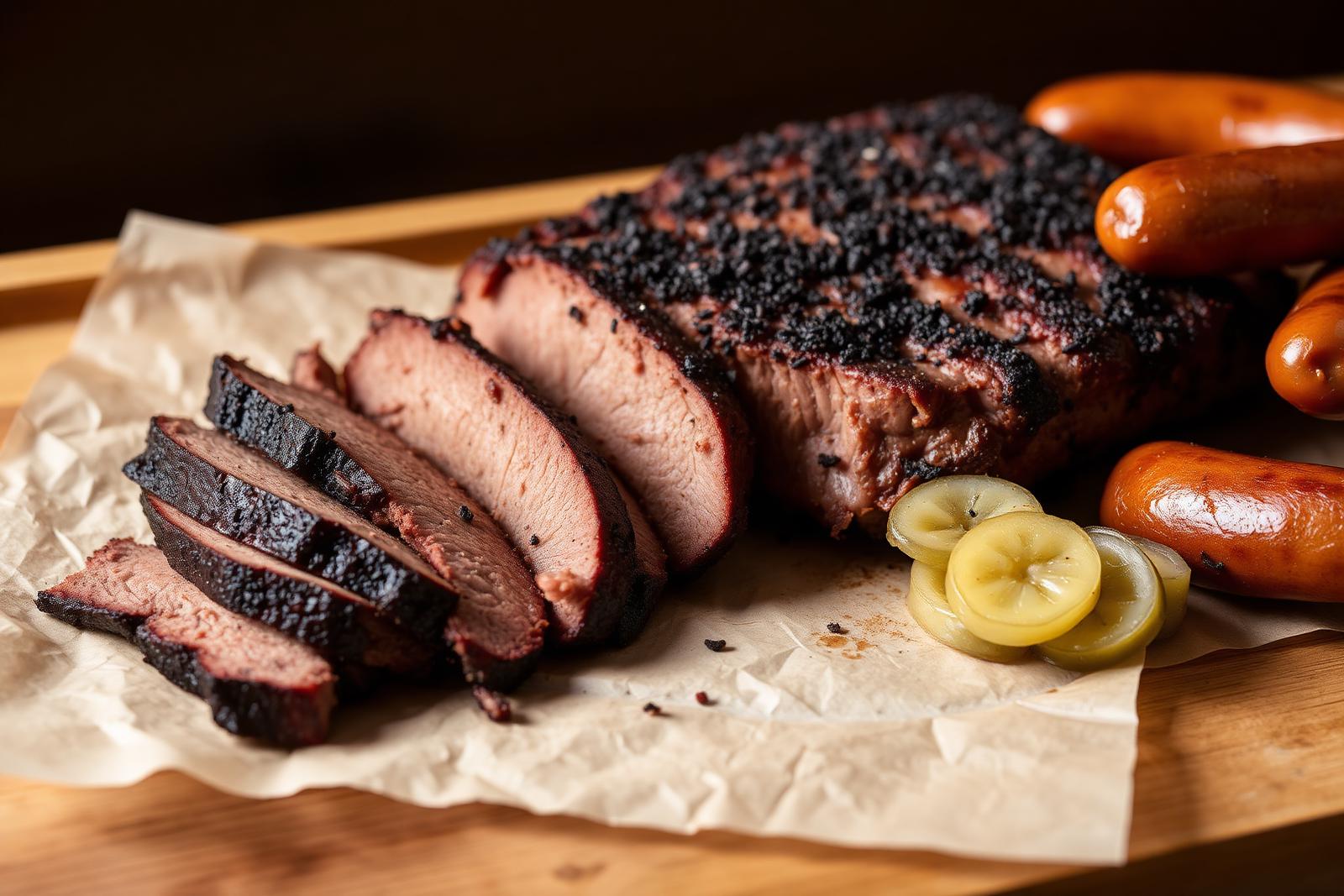
Brisket is the headline, but the deeper story is the old meat-market tradition that linked cattle, German and Czech communities, smokehouses and small-town commerce. A classic Central Texas tray puts sliced brisket beside sausage, ribs, pickles, onions and simple bread, letting smoke and rendered fat carry most of the flavor.
Treat barbecue as a region rather than a single stop. Lockhart, Taylor, Lexington, Elgin and the wider Austin corridor each contribute to the story, and modern pits now reinterpret the tradition across the state. If you only order brisket, you miss how sausage and market-style service explain where the cuisine came from.
02
2. San Antonio Tex-Mex and puffy tacos
San Antonio is one of the best places to understand Tex-Mex as a living city cuisine rather than a generic restaurant category. Puffy tacos, enchiladas, chile con carne, queso, carne guisada and breakfast tacos all overlap here, with family restaurants and neighborhood institutions often mattering as much as polished downtown dining.
A good San Antonio food day mixes formats: breakfast tacos in the morning, a puffy taco or enchilada plate later, then something completely different around the River Walk, the Pearl or an older neighborhood. The contrast is the point.
03
3. Breakfast tacos from the Rio Grande Valley to Austin
Breakfast tacos are one of the most ordinary and most revealing Texas foods. Flour tortillas carry eggs, potatoes, beans, bacon, chorizo, carne guisada, barbacoa or migas, and every city has opinions about the correct tortilla, salsa and filling ratio.
They are especially useful for travelers because the best experience is often not a destination restaurant at all. It can be a bakery, taqueria, gas-station counter or neighborhood drive-through. That everyday quality is part of what makes the breakfast taco so distinctly Texan.
04
4. Czech-Texan kolaches and klobasneks
Central Texas communities shaped by Czech immigration created one of the state's great road-food traditions. Sweet kolaches use fruit, cheese or poppy-seed fillings, while the savory sausage-filled pastries many Texans casually call kolaches are more properly described as klobasneks.
West is the best-known stop, but the larger story extends through Czech-Texan communities across Central Texas. Pair a bakery stop with historic churches, dance halls or town squares and the pastry becomes part of a broader cultural landscape rather than just a snack.
05
5. German-Texan sausage, beer and Hill Country food
German settlement left a durable mark on the Hill Country and Central Texas table through smoked sausage, meat markets, beer culture, bakeries and community festivals. Towns such as Fredericksburg, New Braunfels and surrounding communities connect food with architecture, music and settlement history.
This is also where a food itinerary can become a broader weekend route: market sausage, a bakery, a historic district, a dance hall, wineries or breweries, and nearby parks all fit naturally into the same trip.
06
6. Gulf Coast seafood
The Texas coast adds shrimp, oysters, redfish, snapper, crab and Cajun-influenced crawfish culture to the state food map. Galveston, the upper coast, Corpus Christi and communities farther south each combine working-waterfront traditions with vacation-town dining.
Look beyond fried platters. A strong coastal food trip can include seafood markets, oyster bars, blackened or grilled Gulf fish, shrimp dishes, fish tacos and seasonal crawfish. The best meals often make more sense when paired with the bay, harbor or beach that supplied the culinary identity.
07
7. East Texas fish fries and comfort food
Cornmeal-fried catfish, hushpuppies, beans, greens and homestyle sides connect East Texas to Southern food traditions and to the lakes and rivers that define much of the region. Fish camps and modest local restaurants can be as culturally important as celebrated destination dining rooms.
This part of the trail works especially well with a lake trip. Fishing, a small-town square and a catfish dinner make a coherent TexasDefined itinerary instead of three unrelated stops.
08
8. Hill Country peaches, pecans and seasonal Texas
Texas food changes with the calendar. Hill Country peaches around Fredericksburg and Stonewall, pecans across large parts of the state and spring or summer produce stands turn roadside travel into a seasonal ritual.
That seasonality matters for trip planning. A place can be worth visiting for only a few weeks at peak harvest, which is why produce stands, orchards and small-town festivals should be treated as time-sensitive travel experiences rather than permanent attractions.
09
9. State Fair food and Texas spectacle
The State Fair of Texas turns food into theater. Corny dogs are the enduring symbol, but the broader tradition is experimentation: frying, stacking, stuffing and exaggerating familiar foods until eating becomes part of the fairground spectacle.
This is a different side of Texas food from barbecue or border cuisine, but it belongs in the same story. It shows how deeply the state embraces food as entertainment, ritual and identity.
10
10. The institutions Texans argue about
Whataburger, H-E-B, Blue Bell, Shipley Do-Nuts, Shiner, Buc-ee's and other Texas-rooted institutions inspire unusually personal loyalty. They are not substitutes for independent restaurants, but they help explain everyday Texas habits: the road-trip stop, the grocery run, the late-night burger, the doughnut box and the ice cream in the freezer.
Use them as punctuation marks in a trip rather than the whole itinerary. A Buc-ee's stop makes sense between destinations; an H-E-B visit can reveal regional products; a Blue Bell detour can connect Brenham to a larger Washington County route.
Keep exploring