Food & Barbecue
Texas Barbecue Styles Explained: Central, East, South and West Texas
Texas barbecue is not one style. Learn how Central Texas brisket, East Texas chopped beef, South Texas barbacoa and West Texas live-fire cooking grew from different places, people and traditions.
Ask ten Texans to define Texas barbecue and you may get ten different answers. One person pictures thick slices of pepper-crusted brisket on butcher paper. Another thinks of chopped beef soaked with sauce, smoky sausage snapped from a butcher-paper tray, barbacoa tucked into a tortilla or meat cooked over direct mesquite heat. All of them can be right.
Texas barbecue developed across a state too large, too culturally varied and too tied to regional food traditions to produce a single uniform style. Cattle ranching mattered. So did German and Czech meat markets, African American pit traditions, Mexican and Tejano cooking, local woods, available cuts of meat and the practical need to turn tough or inexpensive pieces into something worth gathering around.
Today the borders between styles are less rigid than they once were. Pitmasters travel, techniques cross-pollinate and restaurants borrow freely from one another. Still, four broad traditions—Central, East, South and West Texas—remain useful for understanding how the state came to taste the way it does.
Central Texas: smoke, salt, pepper and the meat market tradition
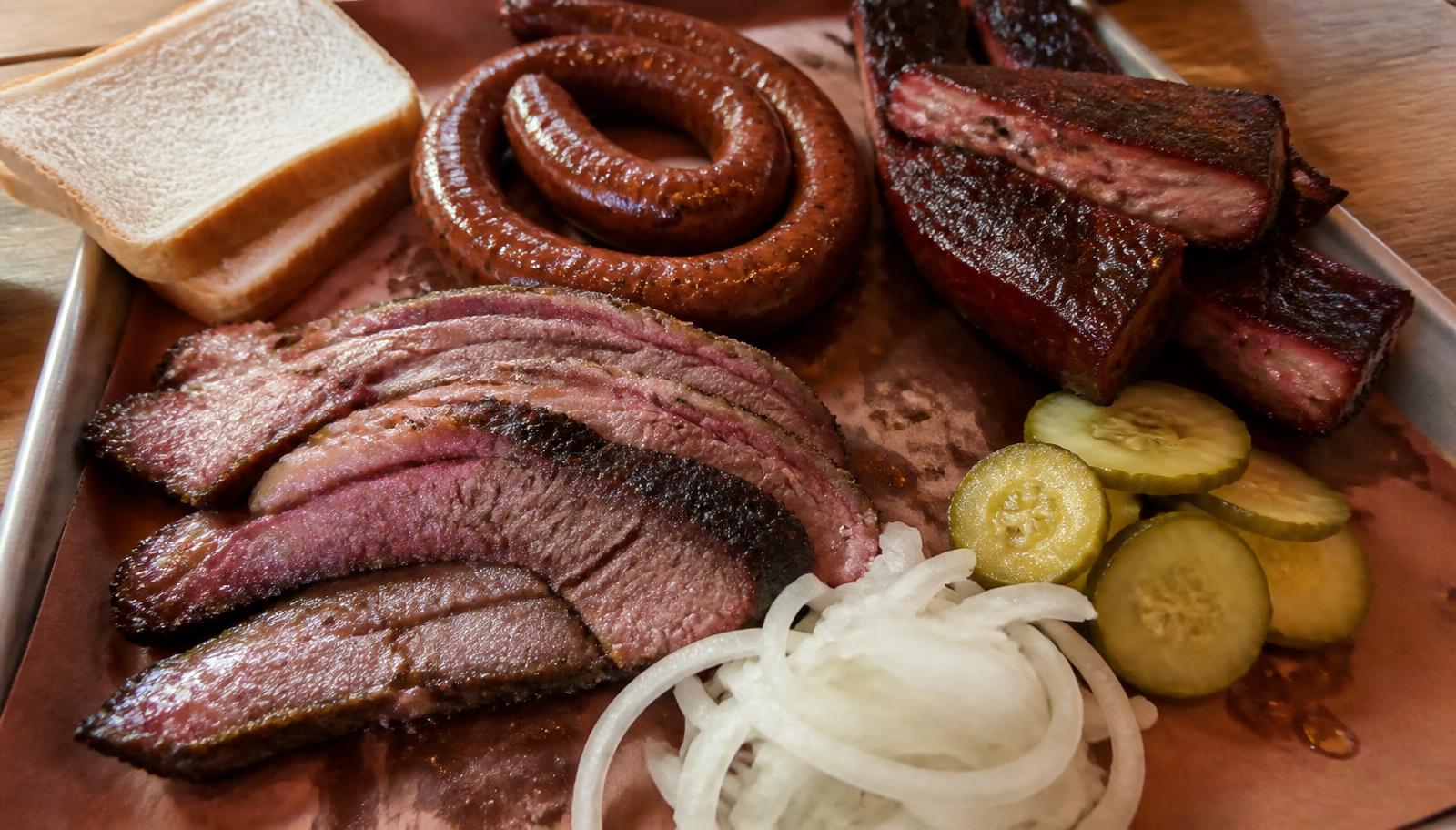
Central Texas barbecue is the style most people outside the state now associate with Texas barbecue. Its visual shorthand is familiar: a dark-barked brisket sliced across the grain, sausage links, ribs, white bread, pickles and onions, often served on butcher paper with sauce treated as optional rather than essential.
The style grew in part from the meat-market culture of Central Texas communities shaped by German and Czech immigration. Butchers already had smokehouses and sausage-making traditions. Unsold meat could be seasoned, smoked and sold ready to eat. Over time, the smoked-meat counter became a destination of its own.
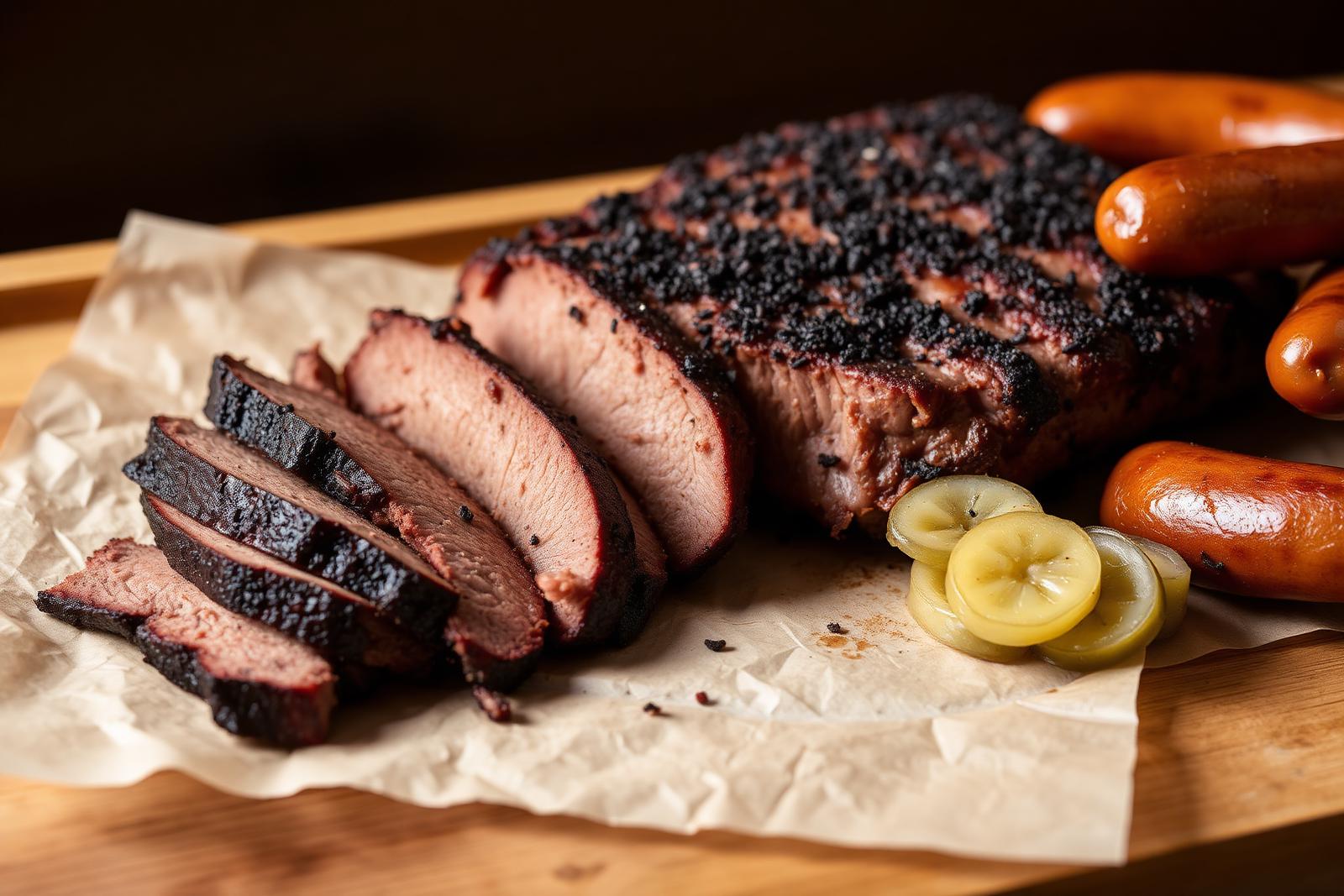
Brisket eventually became the star. Cooked slowly over hardwood—traditionally post oak in much of Central Texas—the tough chest muscle can transform into something tender while still retaining structure. The bark, rendered fat and smoke are expected to carry most of the flavor.
- Signature meat: brisket, especially sliced brisket with a dark bark.
- Common wood: post oak, though pitmasters use other hardwoods too.
- Seasoning: often restrained, with salt and black pepper at the core.
- Service: butcher paper, sausage, ribs, pickles, onions and simple sides.
- Sauce: available in many places, but usually not the point of the meal.
Modern Central Texas barbecue has become increasingly technical. Pitmasters obsess over airflow, fire quality, fat rendering, trimming and hold times. Yet the underlying ideal remains straightforward: the meat should taste unmistakably like meat, smoke and fire rather than a complicated coating.
East Texas: tender meat, chopped beef and sauce
East Texas barbecue comes from a different tradition. It is often more tender, more sauced and more willing to let the meat fall apart than the sliced-brisket ideal associated with Central Texas.
Historically, East Texas barbecue was shaped heavily by African American cooking traditions and the broader food culture of the Deep South. Pork has had a larger role here than in many Central Texas barbecue joints, and beef may be chopped rather than carefully sliced into neat pencils of brisket.
Where Central Texas barbecue often asks you to judge the bark and smoke ring before reaching for sauce, East Texas barbecue is comfortable with sauce becoming part of the finished product. Chopped beef sandwiches are a classic expression: smoky meat, sauce and soft bread working together rather than competing for attention.
- Signature presentation: chopped or finely pulled barbecue, often in sandwiches.
- Texture: very tender, sometimes cooked until the meat pulls or falls apart easily.
- Meats: beef and pork both have deep roots in the region.
- Sauce: more central to the style than in the stereotypical Central Texas presentation.
- Influence: closely connected to African American barbecue traditions and the foodways of the broader South.
The mistake is treating East Texas barbecue as simply a softer or saucier version of Central Texas barbecue. Its history is its own. The chopped texture, sauce, pork traditions and sandwich culture reflect a different regional lineage, not a failure to follow some statewide brisket rule.
South Texas: barbacoa, mesquite and Mexican American influence
South Texas barbecue makes the Mexican and Tejano roots of Texas food impossible to ignore. Here, the story includes ranch cooking, mesquite smoke, fajitas, cabrito and especially barbacoa.
Barbacoa traditionally refers to a slow method of cooking meat associated with underground pits. In South Texas, beef head became closely associated with the dish because slow cooking turns cheek and other collagen-rich muscles tender and rich. Today health rules and restaurant equipment mean much commercial barbacoa is prepared differently, but the cultural connection remains strong.
The most familiar South Texas barbecue meal may arrive not on white bread but in a tortilla. Barbacoa with onion, cilantro, salsa and lime sits at the intersection of barbecue and taco culture so naturally that trying to separate the two misses the point.
Mesquite also matters. It grows readily across South and West Texas and burns hot with a strong flavor. Used carelessly, it can overpower food. Used well, it produces the bold smoke character many Texans associate with ranch-country cooking.
- Signature traditions: barbacoa, beef cheek, fajitas, cabrito and other ranch-influenced cooking.
- Common wood: mesquite is strongly associated with the region.
- Service: tortillas, salsa, onion, cilantro and lime may be as natural as bread and pickles.
- Cultural roots: Mexican, Tejano and ranching traditions are central rather than peripheral.
- Flavor profile: often bolder smoke and stronger seasoning than the minimalist Central Texas stereotype.
South Texas also reminds us that the familiar category called 'Texas barbecue' has always been bigger than smoked brisket. Live fire, whole animals, tortillas and ranch cooking belong to the same state story.
West Texas: direct heat and cowboy-style cooking
West Texas barbecue is often described as cowboy style because it commonly relies on direct heat rather than the indirect smoking method that defines most modern brisket joints.
Instead of placing meat far from the fire and bathing it in smoke for many hours, cooks may position meat over hot coals or a live fire. Mesquite is common because it is abundant and burns hot. The result can resemble grilling more than what many people now imagine when they hear the word barbecue.
That does not make it less Texan. It reflects the practical cooking conditions of ranches, camps and open country where elaborate enclosed smokers were not always the starting point. Fire, iron, meat and available wood were enough.
- Signature technique: direct-heat cooking over coals or live fire.
- Common wood: mesquite.
- Meats: beef is central, but the method can be used across many cuts.
- Setting: ranch, camp and cowboy cooking traditions loom large in the style's identity.
- Flavor: pronounced char and live-fire character rather than the long, gentle smoke profile of offset-pit brisket.
Where sausage fits into the Texas barbecue map
Sausage is one of the threads that connects several Texas barbecue traditions. In Central Texas, Czech and German meat-market influence helped make smoked sausage a barbecue-counter staple. Across the state, communities developed different grinds, spice blends and casing styles.
A good Texas sausage should not be treated as the side act before brisket. It can reveal as much about a barbecue restaurant as the larger cuts do: how the kitchen handles fat, seasoning, smoke, texture and its own regional identity.
What about ribs?
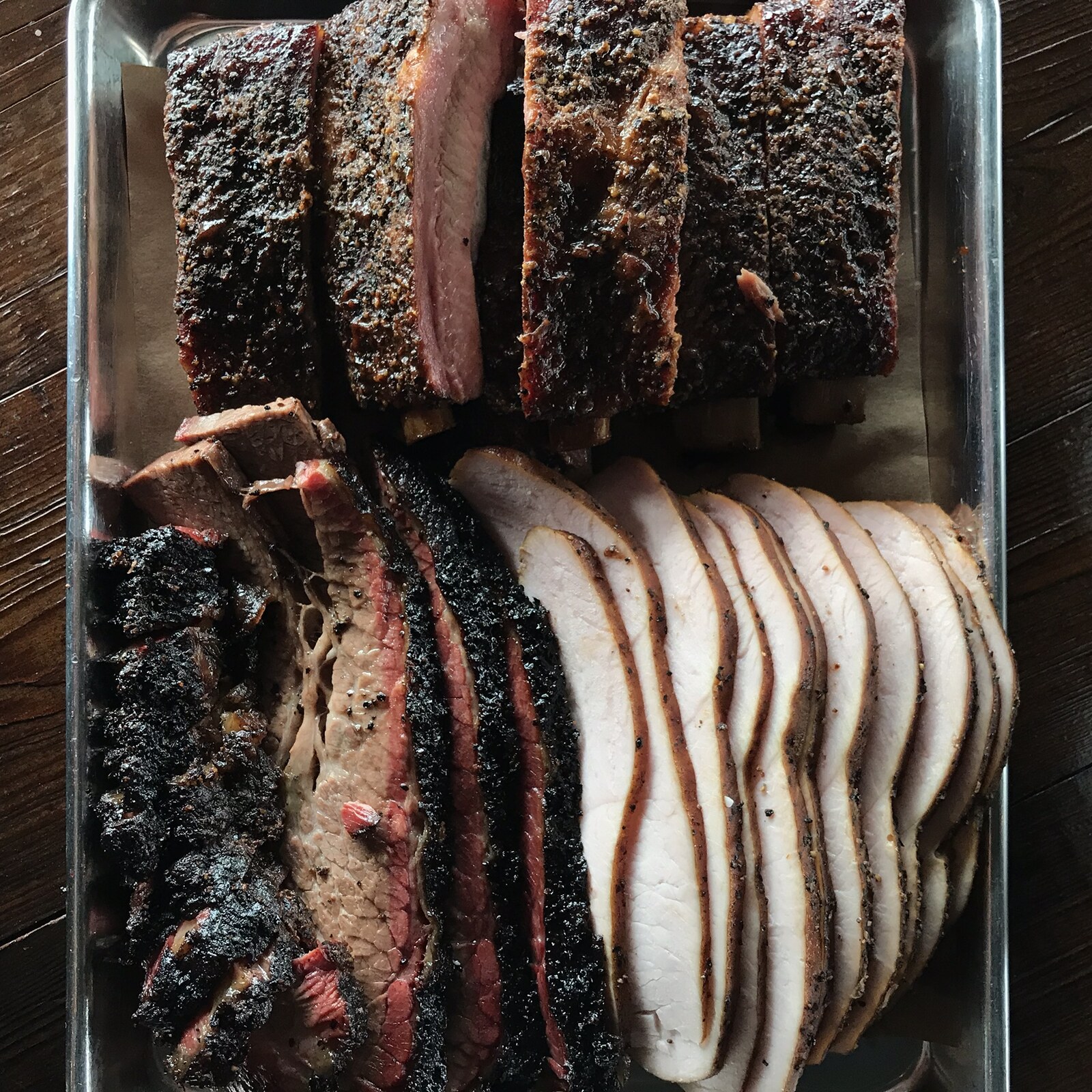
Pork ribs, beef ribs and other smoked cuts appear throughout Texas, even though brisket receives most of the national attention. Beef plate ribs—sometimes called dinosaur ribs because of their size—have become a modern showpiece, while pork spare ribs and baby backs remain fixtures in many barbecue joints.
The important point is that Texas barbecue has never depended on one cut. Brisket became the symbol, but sausage, ribs, pork, goat, beef cheek and other cuts tell equally important parts of the story.
The four-style map is useful, but it is not a rulebook
Texas barbecue is more fluid now than the classic regional map suggests. A Houston pitmaster might cook Central Texas-style brisket, make sausage with Vietnamese flavors and serve a side influenced by the Gulf Coast. A San Antonio restaurant might combine brisket technique with Mexican American ingredients. A Dallas pit might draw from East Texas family traditions while using modern offset smokers.
Houston in particular has become difficult to classify because the city sits at the crossroads of East Texas, the Gulf Coast, Black barbecue traditions, Mexican American cooking and one of the most diverse immigrant populations in the country. The result is not a fifth tidy style so much as proof that Texas barbecue keeps evolving.
How to taste the differences for yourself
You do not need to memorize a barbecue taxonomy before walking into a Texas smokehouse. Start by noticing what the restaurant seems proudest of and how it serves the meat.
- Order a little brisket from both the fatty point and lean flat when available.
- Try the house sausage instead of treating it as filler.
- Notice whether the meat is sliced, chopped, pulled or served in tacos.
- Taste the meat before adding sauce, then taste the sauce on its own.
- Pay attention to the smoke: post oak tends to be gentler, while mesquite can be sharper and more assertive.
- Look beyond brisket. Barbacoa, pork, cabrito, ribs and direct-fire beef may tell you more about the region than the headline cut.
So what defines Texas barbecue?
There is no single answer, and that is the answer. Texas barbecue is a collection of regional traditions shaped by cattle, migration, race, ranching, butcher shops, Mexican and Tejano foodways, African American pit cooking, European sausage-making and the woods growing nearby.
Central Texas gave the state its internationally famous brisket-and-butchers-paper image. East Texas carried forward a saucier, deeply Southern barbecue tradition. South Texas tied smoke to barbacoa, tortillas and ranch culture. West Texas kept direct-fire cooking close to the landscape.
The best way to understand Texas barbecue is not to decide which style is the real one. It is to recognize that a state this large was never going to fit on one plate.
Filed under
- texas barbecue
- central texas barbecue
- east texas barbecue
- south texas barbecue
- west texas barbecue
- brisket
- barbacoa
- texas food
From the magazine