
texas history
Buffalo Soldiers in Texas: The Black Regulars Who Manned the Frontier
After the Civil War, African American soldiers served across Texas in the 9th and 10th Cavalry and the 24th and 25th Infantry. Fort Davis, Fort Concho, Fort McKavett and Fort Lancaster preserve parts of that complicated frontier story.
The phrase “Buffalo Soldiers” is widely used today for African American soldiers who served in the U.S. Army after the Civil War, especially on the western frontier. The historical term first referred to Black cavalrymen and later broadened in public memory to include the Black Regular Army regiments more generally. Its exact origin is uncertain, and National Park Service historians note that the soldiers themselves did not commonly use the name for their units. For that reason, “Black Regulars” is often the more precise term when discussing the soldiers as they understood their own service.
Texas is one of the best places to follow their early history because all four of the post-1869 Black Regular regiments—the 9th and 10th U.S. Cavalry and the 24th and 25th U.S. Infantry—served at Texas posts. Their duties included escorting mail and freight, guarding roads and water sources, building and repairing infrastructure, scouting enormous areas of West Texas and fighting in U.S. Army campaigns against Native nations.
That last point is essential. The soldiers were Black men serving a segregated Army only a few years after emancipation, yet they were also agents of a federal military system that protected settler expansion and fought Apache, Comanche, Kiowa and other Native peoples defending their homelands. Their story contains both the struggle of African Americans for opportunity and citizenship and the violence of U.S. expansion across Indigenous lands.
1866: Congress creates Black Regular Army regiments
On July 28, 1866, Congress reorganized and enlarged the Regular Army. The law created two Black cavalry regiments, the 9th and 10th Cavalry, and four Black infantry regiments: the 38th, 39th, 40th and 41st Infantry. The enlisted ranks were African American; most officers were white, although Black officers gradually entered the Regular Army in small numbers.
A second Army reorganization in 1869 consolidated the four Black infantry regiments into two. The 38th and 41st became the 24th Infantry, while the 39th and 40th became the 25th Infantry. From then on, the 9th Cavalry, 10th Cavalry, 24th Infantry and 25th Infantry became the four principal Black Regular regiments associated with the frontier Army.
Fort Davis: all four regiments in one Trans-Pecos post
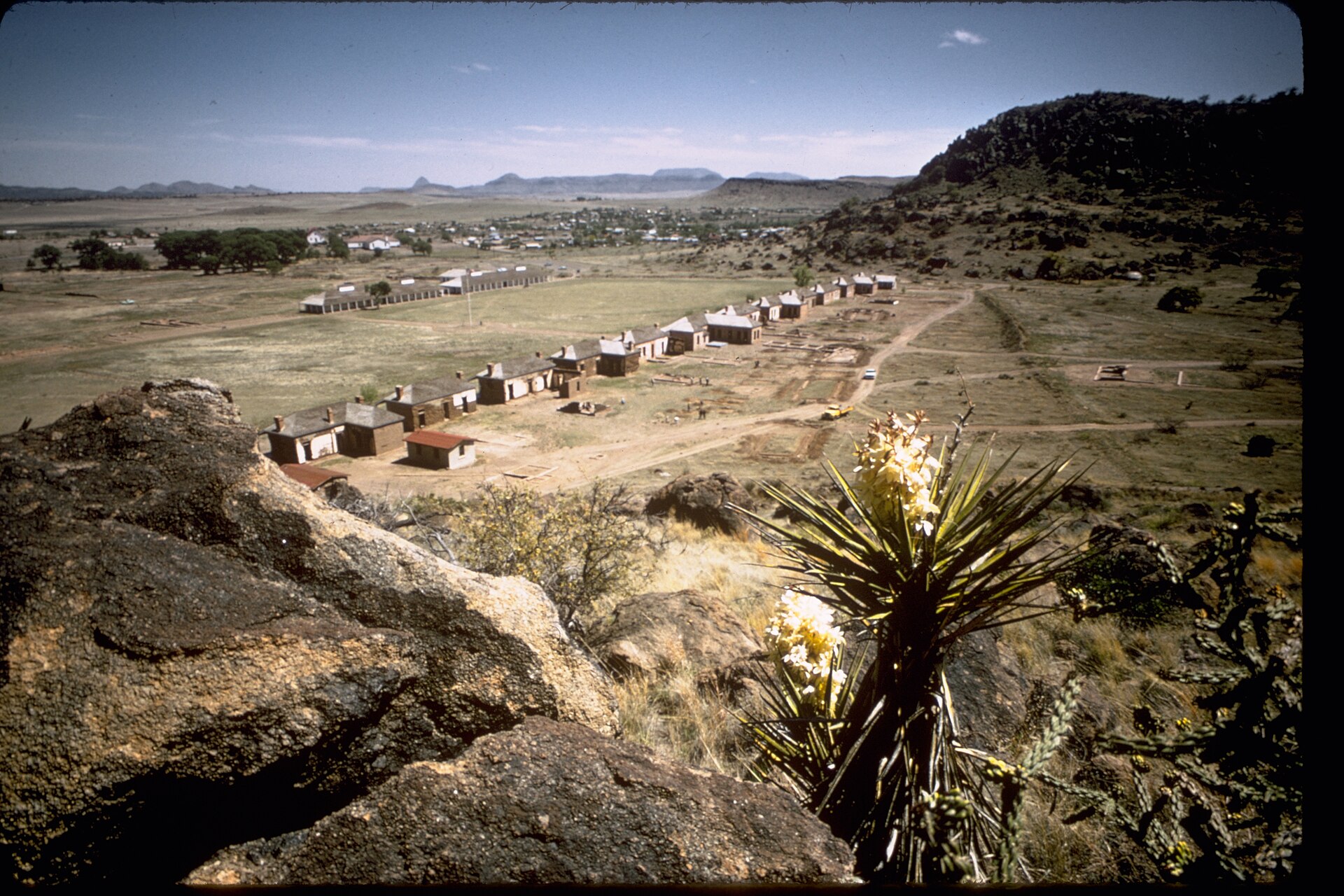
Fort Davis is the strongest single Texas site for understanding the Black Regulars. The Army had abandoned the post during the Civil War. On July 1, 1867, companies of the 9th Cavalry reoccupied it under Lieutenant Colonel Wesley Merritt and began rebuilding the post while also patrolling the San Antonio–El Paso Road.
The work was not limited to combat. Soldiers guarded stage stations, escorted mail coaches and wagon trains, repaired roads, protected water sources, assisted survey parties and helped extend telegraph communications. Those duties reveal why frontier forts were logistical systems rather than isolated defensive compounds.
Units of all four Black Regular regiments served at Fort Davis between 1867 and 1885. The 9th Cavalry remained a major presence until 1875. The 24th and 25th Infantry rotated through the post. Elements of the 10th Cavalry arrived in the mid-1870s, and Fort Davis later became the regiment's headquarters during part of the 1880s.
The Victorio Campaign and the geography of water
One of the largest military operations involving Black Regulars in the Trans-Pecos came during the Victorio Campaign of 1879–1880. Victorio, a Warm Springs Apache leader, led a mobile group through New Mexico, West Texas and northern Mexico while U.S. and Mexican forces attempted to cut off movement between mountain ranges and water sources.
Colonel Benjamin Grierson of the 10th Cavalry understood that water was the key to movement across the arid region. Six troops of the 10th Cavalry and a company of the 24th Infantry patrolled a broad zone from the Van Horn Mountains toward the Delaware Mountains and Sierra Diablo. Fighting at Tinaja de las Palmas and Rattlesnake Springs helped prevent Victorio's force from reaching key water and returning north toward New Mexico.
The campaign shows why the landscape matters. West Texas military history was shaped by distances that could not be crossed safely without reliable springs, waterholes, wagon roads and supply depots. Cavalry mobility depended as much on water for horses as on weapons or tactics.
Fort Concho: a crossroads for every Black Regular regiment
Fort Concho was established in 1867 beside the Concho River, where San Angelo later developed. Over its military life, all four Buffalo Soldier regiments served at the post. The 10th Cavalry made Fort Concho an important headquarters before moving much of its command farther west to Fort Davis in 1882.
The post anchored roads and communications across a wide section of West Texas. Soldiers escorted travelers, scouted the region and supported campaigns across the plains. The surviving fort complex in San Angelo is therefore an important urban counterpart to Fort Davis: visitors can see how a major military post helped generate the civilian town that outlived it.
Fort McKavett: service, daily life and Sgt. Emanuel Stance
Fort McKavett, west of Menard, also hosted soldiers from all four Black Regular regiments. The site's surviving buildings make daily garrison life unusually tangible: barracks, officers' quarters, hospital structures, parade ground and support buildings reveal the routine work behind frontier operations.
Fort McKavett is also connected to Sergeant Emanuel Stance of the 9th Cavalry. Stance received the Medal of Honor for actions in 1870 while serving from the post. The Texas Historical Commission identifies his award as the first Medal of Honor awarded to an African American soldier for service after the Civil War.
His story is useful precisely because it is not the whole story. Medal of Honor narratives can focus attention on dramatic moments, while most soldiers' service consisted of long patrols, construction, livestock care, guard duty, escort missions, cooking, maintenance and the repetitive labor required to keep an isolated post operating.
Fort Lancaster: an 1867 attack on Company K, 9th Cavalry
Fort Lancaster had been established in the 1850s on the San Antonio–El Paso Road and was later used as a sub-post after the Civil War. In 1867, Company K of the 9th Cavalry defended the site during an attack by a large force that the Texas Historical Commission describes as including Kickapoo, Comanche, Apache and other fighters.
The engagement is often highlighted because Fort Lancaster is the only U.S. Army fort in Texas recorded as having come under a direct Native attack. The battlefield and ruined structures help visitors understand how exposed small detachments could be when guarding roads and livestock far from larger garrisons.
A segregated Army could still offer one of the few stable federal careers available to Black men
Military service after emancipation carried contradictions. Black enlisted men faced discrimination, racial violence, unequal treatment and a command structure dominated by white officers. At the same time, Regular Army pay, food, clothing, housing and opportunities for literacy or skilled work could provide a degree of economic stability difficult to find elsewhere in the postwar United States.
Some veterans used military wages and experience to build civilian lives as landowners, tradesmen and business owners. Others remained in the Army for long careers. Their presence also challenged contemporary assumptions about citizenship and military competence at a time when Reconstruction rights were being violently contested across the South.
Black soldiers and Native peoples: two histories that must be held together
It is tempting to tell Buffalo Soldier history only as a civil-rights story. That leaves out the Army's mission. The frontier post system protected mail routes, wagon roads, settlement and federal claims to land. Patrols and campaigns often targeted Native peoples whose own economies, migration routes and political independence were being destroyed by military pressure and settler expansion.
The fact that Black soldiers had recently emerged from a nation built on slavery does not erase their role in those campaigns. Likewise, their participation in U.S. expansion does not erase the racism they faced or the significance of their military service. The history is strongest when neither side of that contradiction is simplified.
Four Texas places that make the story visible
- Fort Davis National Historic Site: the most complete Texas setting for the 9th and 10th Cavalry and 24th and 25th Infantry, with preserved buildings and extensive National Park Service interpretation.
- Fort Concho in San Angelo: a major post where all four Black Regular regiments served and where the military road network helped shape the growing town.
- Fort McKavett State Historic Site: one of the best-preserved frontier posts, connected to all four regiments and to Medal of Honor recipient Sgt. Emanuel Stance.
- Fort Lancaster and Battlefield State Historic Site: a road-guarding post where Company K of the 9th Cavalry defended the site during the 1867 attack.
Why Buffalo Soldier history belongs near the center of Texas history
The Black Regulars connect several major Texas stories at once: emancipation and Reconstruction, the professional U.S. Army, westward settlement, federal infrastructure, African American citizenship and the dispossession of Native nations. Their history also changes the way visitors read the forts themselves. A barracks is not just a frontier building; it is a workplace where men lived inside the racial order of the nineteenth-century Army while carrying out the policies of an expanding United States.
Fort Davis, Fort Concho, Fort McKavett and Fort Lancaster are therefore more than military attractions. Read together, they form a statewide archive of the Black Regulars and of the larger, often conflicting forces that remade Texas after the Civil War.
Image credit: National Park Service · Public domain · Wikimedia Commons
Primary source: National Park Service ↗
Filed under
- Buffalo Soldiers
- Black Regulars
- African American Texas history
- Fort Davis
- Fort McKavett
- Fort Concho
- Fort Lancaster
- Texas frontier forts
- Texas military history
Plan the trip
Places connected to this story
Destinations explicitly tied to this article in the Texas Defined guide.
Fort Davis · Jeff Davis County
Fort Davis National Historic Site
One of the Southwest's best-preserved frontier Army posts, set beneath the Davis Mountains with restored barracks, officers' quarters and exhibits interpreting soldiers, civilians and Buffalo Soldiers on the nineteenth-century Texas frontier.
Best season: Fall through spring for mild temperatures; summer mornings are more comfortable for walking the open post grounds- Restored frontier military buildings
- Buffalo Soldier history
- Davis Mountains setting
Fort McKavett · Menard County
Fort McKavett State Historic Site
The remarkably preserved West Texas post interprets U.S. Army life and conflict on the 19th-century frontier, including the service of Buffalo Soldiers. Its surviving buildings and remote setting create one of Texas' clearest physical impressions of an Indian Wars-era military post.
Best season: Year-round; spring and fall are usually the most comfortable for outdoor portions of a visit.Updated Aug 2026- Buffalo Soldiers
- frontier forts
- military history
Sheffield · Crockett County
Fort Lancaster State Historic Site
Established in 1855, Fort Lancaster protected a strategic overland route linking San Antonio and El Paso across West Texas. The isolated ruins make the scale, distance and logistical difficulty of 19th-century travel across the Edwards Plateau immediately understandable.
Best season: Year-round; spring and fall are usually the most comfortable for outdoor portions of a visit.Updated Aug 2026- frontier forts
- San Antonio-El Paso road
- West Texas


From the magazine
More stories to read next
Then & Now
Texas National Cemeteries: Fort Sam Houston, Houston and Dallas–Fort Worth
August 21, 2026 · About 12 minutes
Then & Now
Texas Military Museums & Historic Sites: The Best Places to See the Story in Person
August 20, 2026 · About 19 minutes

.jpg%3Fwidth%3D1600)