
texas history
Texas in the Civil War: Battlefields, Emancipation, Reconstruction and Memory
Follow Texas from secession and Gulf Coast fighting through Palmito Ranch, Juneteenth, emancipation, Reconstruction and the later places where Texans preserved—and reshaped—the war's memory.
Texas entered the Civil War with a geography unlike most Confederate states. It had a long Gulf coastline, an international border with Mexico, an enormous western frontier and only a limited rail network. Those features kept the state far from many of the war's largest battles while making its ports, cattle, cotton, horses, border crossings and military roads strategically important.
A useful Texas Civil War trip therefore looks different from a Virginia battlefield tour. The key places are separated by hundreds of miles and represent different parts of the conflict: political secession in Austin, federal surrender in San Antonio, naval and amphibious fighting at Galveston and Sabine Pass, cotton trade through the Rio Grande, the final land battle at Palmito Ranch, federal enforcement of emancipation, Reconstruction and the later construction of Civil War memory.
1861: Texas leaves the Union
The secession process unfolded in stages. A convention meeting in Austin adopted an Ordinance of Secession on February 1, 1861. Texas voters ratified the decision on February 23. The Confederate government accepted Texas on March 1, and the Texas convention accepted Confederate statehood in early March. Governor Sam Houston opposed secession and refused to take the required Confederate loyalty oath, ending his governorship.
The stated causes of Texas secession included the defense of slavery. The convention's own Declaration of Causes repeatedly described slavery and white supremacy as central interests. That primary-source record is essential context for every military event that followed in the state.
Even before the secession process was complete, control of federal military property changed hands. On February 16, U.S. Army commander David E. Twiggs surrendered federal property and posts in Texas to state forces in San Antonio and ordered federal soldiers toward the coast for evacuation. The transfer effectively removed the regular Army from a frontier system it had spent years building.
Texas soldiers mostly fought outside Texas
Although the state saw important coastal and border engagements, most Texas soldiers who experienced sustained combat did so elsewhere. Texas units served across the Trans-Mississippi, western and eastern theaters. Cavalry, infantry and artillery formations fought in campaigns from Arkansas and Louisiana to Tennessee, Mississippi, Georgia and Virginia.
That fact can distort public memory in two directions. A Texas-only battlefield map understates how many Texans fought outside the state, while a national Civil War map can make Texas itself appear inactive. The better picture holds both together: Texas supplied troops to distant armies while defending ports, trade routes and the international border at home.
Galveston: a port worth fighting for
Galveston was Texas' most important Gulf port and one of the state's largest commercial centers. Union naval forces occupied the harbor and island in 1862, but Confederate forces under Major General John B. Magruder launched a combined land-and-water attack before dawn on January 1, 1863.
The Battle of Galveston returned the island to Confederate control for the remainder of the war. The fight included artillery, improvised Confederate gunboats and close action in the harbor. It showed how a relatively small port city could matter far beyond its local population because control of the coast affected blockade strategy, commerce and access to the Gulf.
Modern Galveston has changed dramatically, so the battle is harder to read on the ground than a preserved rural battlefield. The strongest visit pairs historical interpretation with the harbor itself, then continues forward two years to the arrival of federal occupation forces in June 1865.
Sabine Pass: the invasion that failed
On September 8, 1863, Union forces attempted to enter Texas through Sabine Pass near the Louisiana line. The expedition included gunboats and troop transports carrying thousands of soldiers intended for operations inside Texas. A small Confederate garrison at Fort Griffin, commanded by Lieutenant Richard W. Dowling, manned a limited number of guns overlooking the channel.
The defenders used carefully ranged artillery fire to disable and capture Union gunboats, forcing the expedition to withdraw before its soldiers could land. The battle became one of the most celebrated Confederate victories in Texas because of the disparity between the small garrison and the much larger force turned back offshore.
Sabine Pass Battleground State Historic Site preserves the setting better than an urban battlefield can. The waterway is the key to understanding the engagement. This was not a conventional infantry clash across open ground; it was a fight over a narrow approach channel where artillery placement and navigation constrained a much larger force.
The Rio Grande: cotton, neutral Mexico and a porous blockade
The lower Rio Grande became one of the most important economic corridors in Confederate Texas. Because Mexico was neutral, cotton could move overland to the river, cross into Mexico and reach international shipping from ports near the river's mouth. Imported goods and military supplies could move back in the opposite direction.
That trade gave the region strategic value even when the rest of the Gulf Coast was constrained by the Union blockade. Brownsville, Brazos Santiago and the approaches to the Rio Grande changed hands during the war as Union forces tried to disrupt trade and Confederate forces tried to keep the corridor open.
The border also makes simplistic maps misleading. Military control on one bank of the river did not automatically stop commerce on the other. International law, local merchants, Mexican politics, river crossings and shifting garrisons all shaped what could move through the region.
Palmito Ranch: the final land battle
On May 12–13, 1865, Union and Confederate forces fought near Palmito Ranch east of Brownsville. The engagement occurred more than a month after Robert E. Lee surrendered the Army of Northern Virginia at Appomattox. Confederate forces won the local battle, but the larger war had already been decided.
Palmito Ranch is recognized by the Texas Historical Commission as the final land battle of the Civil War. That distinction can make the site sound like an isolated historical oddity, but the Rio Grande trade corridor explains why armed forces were still facing one another there. The region had remained economically and strategically active to the end.
The battlefield is an unusually open historical landscape with limited visitor infrastructure. That makes preparation important. Read the interpretation before arriving, bring water and sun protection, and treat the site as a landscape to study rather than a museum campus.
June 1865: military defeat, federal occupation and Juneteenth
Confederate military collapse did not instantly enforce emancipation throughout Texas. On June 19, 1865, Major General Gordon Granger arrived in Galveston with federal troops and issued General Orders No. 3, announcing that enslaved people in Texas were free and that the United States government would enforce emancipation.
Black Texans began commemorating June 19 the following year. Juneteenth grew from community celebrations into a statewide Texas holiday and eventually a federal holiday. Its origin is inseparable from the end of slavery and the presence of federal military authority, but the tradition itself belongs to a much larger Black history of family, freedom, citizenship, institution-building and memory.
A Civil War guide should therefore not treat Juneteenth as a final military trophy. It is the point where the military chronology opens into Reconstruction and the long struggle over what freedom would mean in practice.
Reconstruction: follow the war into homes and plantation landscapes
The strongest way to continue the story after 1865 is to leave the battlefield network and visit places where emancipation, labor, politics and family life changed over decades. The Texas Historical Commission includes Levi Jordan Plantation, Varner-Hogg Plantation, Sam Bell Maxey House and Starr Family Home in its Civil War and Reconstruction learning network because each preserves a different piece of that transition.
Levi Jordan Plantation and Varner-Hogg Plantation are especially important because the postwar story cannot be understood without the people who had been enslaved there. Archaeology, surviving buildings and community histories reveal emancipation as the beginning of new struggles over labor, land, family autonomy, contracts and opportunity rather than a clean endpoint.
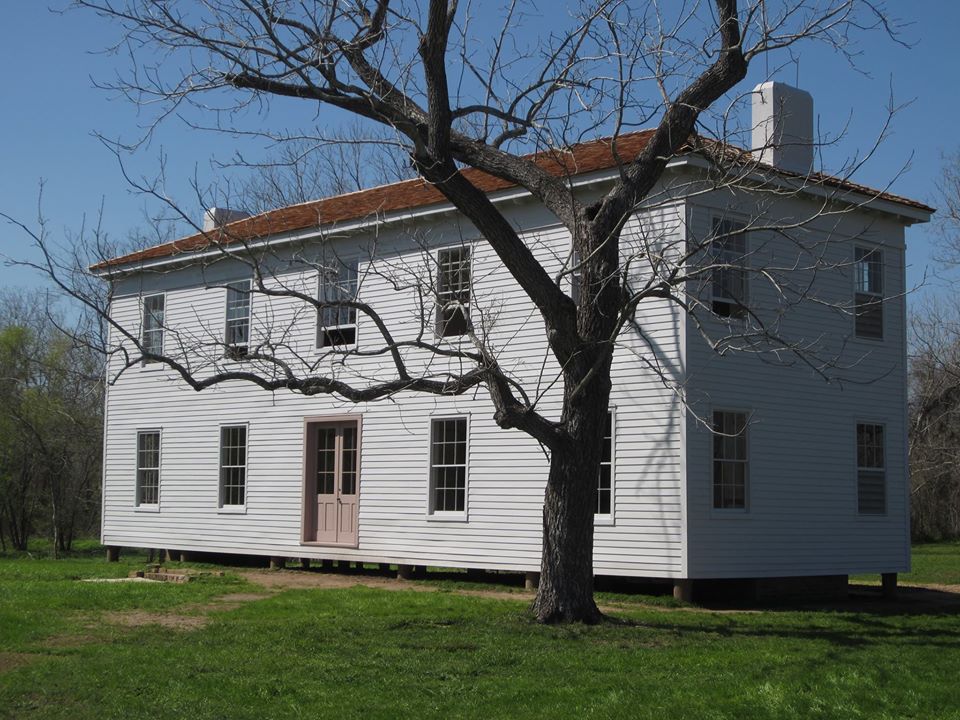
Sam Bell Maxey House shifts the perspective to politics and household life. Maxey had served as a Confederate general, but the preserved Paris home interprets a family navigating Reconstruction and later national political life. Starr Family Home adds another East Texas household whose preserved spaces help connect private life, civic status and a changing postwar society.
Postwar memory: what Texans chose to preserve
Civil War memory in Texas took many forms after 1865. Veterans' organizations held reunions. Communities erected monuments. Homes associated with military and political figures became museums. Later preservation efforts began treating battlefields themselves as historical landscapes rather than simply commemorative grounds.
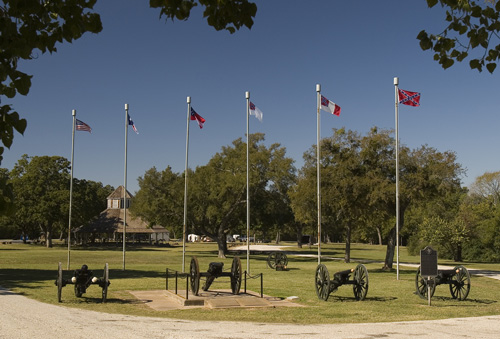
Confederate Reunion Grounds near Mexia preserves a site used for large veterans' gatherings from the late nineteenth century into the twentieth. Its value is different from Sabine Pass or Palmito Ranch: it helps explain how Confederate memory was organized, ritualized and transmitted after the war. Reading it critically requires separating the history of wartime events from the later history of commemoration.
The grounds also carry histories that predate the reunions and extend beyond them. The site's interpretation includes earlier Indigenous use of the Navasota River landscape and later oil-boom history, making it a useful example of how one protected place can contain several different historical layers.
A practical Texas Civil War and Reconstruction itinerary
The distances are too large for one coherent weekend route, so organize the sites regionally and by theme.
- Galveston: study the 1863 battle, the port and the June 1865 arrival of federal occupation forces; connect the military story directly to Juneteenth history.
- Upper Gulf Coast: visit Sabine Pass Battleground and use the channel geography to understand the failed 1863 Union invasion.
- Rio Grande Valley: combine Brownsville border history with Palmito Ranch Battlefield and the wider cotton-trade corridor.
- Brazoria County: pair Levi Jordan and Varner-Hogg to move from slavery into emancipation, Reconstruction, changing labor systems and archaeology.
- Central Texas memory: use Confederate Reunion Grounds to examine how veterans and later generations commemorated the war.
- North and East Texas: Sam Bell Maxey House and Starr Family Home add postwar household, political and civic perspectives.
What the Texas landscape adds
The Texas Civil War is easiest to understand when geography leads the interpretation. Galveston explains ports and naval power. Sabine Pass explains channels and coastal defense. The Rio Grande explains international trade and the limits of a blockade. Palmito Ranch explains why fighting could persist at the far edge of a collapsing Confederacy. Galveston again explains why federal occupation mattered to emancipation.
The Reconstruction sites then force the story beyond military surrender. Plantation landscapes, preserved homes and reunion grounds show how freedom, politics, labor and public memory continued to change for generations after the armies stopped fighting.
Together those places show that Texas was neither a peripheral spectator nor the center of the national conflict. It was a distant but strategically important part of a much larger war—one whose military end in Texas cannot be separated from slavery, emancipation, Reconstruction and the contested memory that followed.
Image credit: Junglecat · CC BY-SA 4.0 · Wikimedia Commons
Primary source: Texas Historical Commission ↗
Filed under
- texas civil war
- reconstruction texas
- sabine pass
- palmito ranch
- juneteenth
- texas military history
- emancipation texas
- civil war memory
Plan the trip
Places connected to this story
Destinations explicitly tied to this article in the Texas Defined guide.
Sabine Pass · Jefferson County
Sabine Pass Battleground State Historic Site
The site marks the 1863 Civil War battle in which a small Confederate force stopped a much larger Union operation near the mouth of the Sabine River. Its Gulf Coast setting helps explain the strategic importance of ports, waterways and access to Texas during the Civil War.
Best season: Year-round; spring and fall are usually the most comfortable for outdoor portions of a visit.Updated Aug 2026- Civil War
- Gulf Coast
- military history
Brownsville · Cameron County
Palmito Ranch Battlefield
Palmito Ranch is associated with the final land battle of the American Civil War, fought near the Rio Grande in May 1865. The remote battlefield is best approached as a landscape-history stop that explains why fighting continued in Texas after major Confederate armies had surrendered elsewhere.
Best season: Year-round; spring and fall are usually the most comfortable for outdoor portions of a visit.Updated Aug 2026- Civil War
- battlefields
- Rio Grande
Mexia · Limestone County
Confederate Reunion Grounds State Historic Site
Civil War veterans and their families gathered on this Navasota River site for large reunions from the late 19th century into the 20th century. The grounds are useful for examining how Texans remembered, commemorated and reshaped Civil War memory after Reconstruction.
Best season: Year-round; spring and fall are usually the most comfortable for outdoor portions of a visit.Updated Aug 2026- Civil War memory
- Reconstruction
- public commemoration
Paris · Lamar County
Sam Bell Maxey House State Historic Site
The Paris home follows the Maxey family from the Civil War and Reconstruction through the social changes of the early 20th century. Period rooms and family objects make broad political eras feel personal, especially for travelers exploring Northeast Texas courthouse towns.
Best season: Year-round; spring and fall are usually the most comfortable for outdoor portions of a visit.Updated Aug 2026- Reconstruction
- historic homes
- Northeast Texas
Brazoria · Brazoria County
Levi Jordan Plantation State Historic Site
The plantation landscape preserves evidence of the people—enslaved and free—whose labor and communities shaped a major sugar and cotton operation. Interpretation centered on multiple perspectives makes this an important stop for understanding slavery, emancipation and postwar community life on the Gulf Coast.
Best season: Year-round; spring and fall are usually the most comfortable for outdoor portions of a visit.Updated Aug 2026- slavery and emancipation
- plantation history
- African American history
West Columbia · Brazoria County
Varner-Hogg Plantation State Historic Site
The plantation site preserves more than a century of layered stories involving enslaved labor, emancipation, agriculture, oil wealth and the families who controlled or worked the land. Its interpretation is most valuable when treated as a long history of changing power, labor and community rather than as a single historic house.
Best season: Year-round; spring and fall are usually the most comfortable for outdoor portions of a visit.Updated Aug 2026- slavery and emancipation
- plantation history
- Texas oil era



From the magazine
More stories to read next
Then & Now
Texas National Cemeteries: Fort Sam Houston, Houston and Dallas–Fort Worth
August 21, 2026 · About 12 minutes
Then & Now
Texas Military Museums & Historic Sites: The Best Places to See the Story in Person
August 20, 2026 · About 19 minutes

.jpg%3Fwidth%3D1600)