texas history
Texas Frontier Forts Road Trip: Four Army Posts That Explain the West
Fort Martin Scott, Fort Griffin, Fort McKavett and Fort Lancaster reveal how soldiers, settlers, travelers, ranchers and Native nations collided across the Texas frontier.
Texas frontier forts are easiest to misunderstand when they are treated as a chain of interchangeable stone ruins. They were not identical, and they did not exist in a vacuum. Each post responded to a different stretch of geography, a different transportation problem and a different phase of U.S. expansion across lands already occupied and used by Native nations.
A good fort road trip therefore is not about collecting parade grounds. It is about comparing systems. Where did water come from? Which road or settlement was being protected? How far away was the next post? Who served there? What communities appeared nearby? Which Native peoples were displaced, fought or negotiated with expanding U.S. power? The four sites on this route make those questions visible in very different landscapes.
How to plan the route
The forts are spread across a large portion of Texas, so this is best treated as a multi-day westbound road trip rather than one weekend loop. A practical sequence begins at Fredericksburg, moves north toward Albany for Fort Griffin, turns southwest to Fort McKavett, and then continues west to Fort Lancaster. Travelers can reverse the order depending on where they enter the state.
- Fort Martin Scott: Fredericksburg and the Hill Country settlement frontier.
- Fort Griffin: North Texas ranch country, cattle trails and the boomtown world around an Army post.
- Fort McKavett: a remarkably legible military landscape in remote Menard County country.
- Fort Lancaster: the San Antonio-El Paso road and the logistics of crossing the arid West Texas interior.
Stop 1: Fort Martin Scott — Army expansion meets German Texas
Fort Martin Scott stands just outside Fredericksburg, which makes it one of the best places to see two frontier stories occupy the same geography. The Army post dates to the years after the United States annexed Texas and the Mexican-American War, while Fredericksburg had been founded by German immigrants only a short time earlier.
That overlap is important. The frontier was not simply a line where soldiers faced west. It was a zone of immigrant settlement, Indigenous homelands, military roads, trade, ranching and competing claims to land. Fredericksburg's later identity as a heritage and tourism town can make the military post feel like a side attraction, but the fort helps explain why the late-1840s Hill Country was politically and geographically unsettled.
Walk the grounds before heading into the National Museum of the Pacific War or Fredericksburg's historic core. The contrast between a modest frontier post and a major twentieth-century military museum creates a useful century-long arc of Texas military history without leaving town.
Stop 2: Fort Griffin — the post and the town that grew beside it
Fort Griffin offers a different frontier. Established after the Civil War, the post became associated with campaigns on the Southern Plains and the military network that expanded through North and West Texas. The surrounding Clear Fork country also became cattle and ranching country, linking the fort to economic changes happening far beyond the parade ground.
What makes Fort Griffin especially useful is the relationship between military post and civilian boomtown. Frontier forts attracted merchants, saloons, laborers, freighters and opportunists because soldiers created demand. That civilian economy is part of the history, not an interruption to it.
The Official State of Texas Longhorn Herd, kept at Fort Griffin, adds another layer. Longhorns connect the region to the cattle-drive era that followed the Civil War and helped turn open-range ranching into one of the defining stories of Texas popular culture. Seeing the herd in the same landscape as the fort helps connect military expansion, ranching and the transformation of the Plains.
Stop 3: Fort McKavett — read the fort as a working system
Fort McKavett is one of the strongest places in Texas for understanding how a frontier post functioned day to day because so much of the built environment remains legible. Instead of focusing only on one headquarters building, look at the relationships among barracks, hospital functions, officers' quarters, storage, kitchens, animals and water.
Military life depended on logistics. Food, ammunition, medicine, mail, building material, horses and people had to move across long distances before railroads and paved highways compressed the map. The preserved post layout makes those practical questions easier to imagine.
Fort McKavett is also an important place to discuss Buffalo Soldiers. Black U.S. Army troops served across the post-Civil War West and were central to the Army's frontier campaigns, even as they faced discrimination within the country and institution they served. That history belongs inside the fort story rather than as a separate sidebar.
Stop 4: Fort Lancaster — isolation is part of the artifact
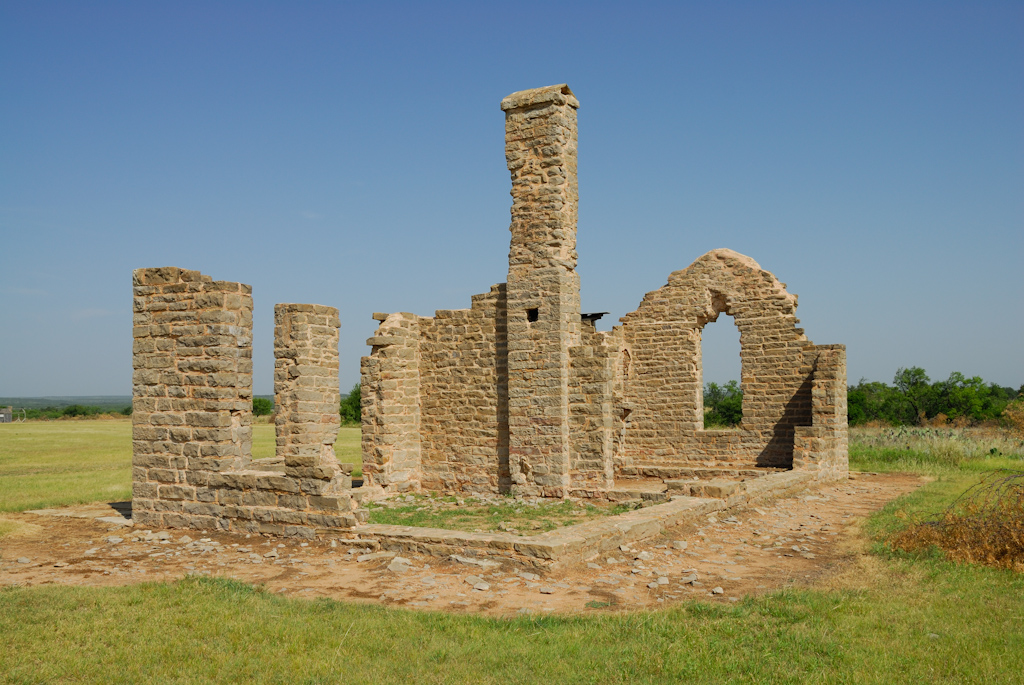
Fort Lancaster's greatest interpretive asset is its remoteness. The post protected and supported movement along the San Antonio-El Paso road, a route crossing enormous distances through difficult country. Standing at the site makes the basic logistical problem obvious: travelers and military units could not simply stop at the next town every few miles.
The ruined buildings matter, but so do the plateau, creek and surrounding open land. This is a fort where visitors should resist the instinct to judge the experience by how much architecture remains standing. The landscape explains why the place existed.
Fort Lancaster is also connected to a significant 1867 conflict involving Buffalo Soldiers and a large attacking force. As with other frontier sites, interpretation is strongest when military history is placed beside Native history rather than told as a one-sided story of inevitable westward movement.
What the forts were actually doing
The term 'fort' can suggest a castle designed to withstand siege. Many Texas frontier posts were something different: administrative and logistical bases supporting patrols, roads, mail routes, settlement and military campaigns across large territories. Their influence extended much farther than their walls or buildings.
That is why water and transportation repeatedly determine where these sites appear on the map. A post needed a workable route, access to water and connections to supply lines. In an era when moving freight could take weeks, geography was strategy.
The Native history cannot be separated from the military history
Any frontier-fort itinerary needs to make room for the peoples whose homelands and movement patterns were being constrained by U.S. expansion. Comanche, Kiowa, Apache and other Native histories differ by region and period, but none of these posts should be interpreted as though soldiers were operating in empty country.
The Army network helped impose new control over land, travel and settlement. Military campaigns, reservation policy, destruction of bison herds, expanding ranching and settler migration all contributed to profound disruption. The forts are therefore sites of national expansion and sites where that expansion had human costs.
Add the towns, not just the forts
Fredericksburg and Albany are particularly useful companions because they show how civilian communities developed distinct identities around the same broad frontier geography. Menard and Ozona provide practical bases for the more remote legs and add courthouse, ranching and transportation history.
A fort road trip becomes much richer when meals, overnight stops and downtown walks are treated as part of the historical geography. Army posts did not exist apart from commerce and settlement, and modern travelers can still see how roads, towns and ranch country fit together.
Planning notes
- Check official site pages before departure; remote sites may have seasonal schedules, limited services or weather-sensitive conditions.
- Carry fuel and water conservatively on the Fort McKavett and Fort Lancaster legs rather than assuming urban service intervals.
- Use site maps. The relationship among buildings is often more important than any single ruin.
- Build in landscape time. At Fort Griffin, McKavett and Lancaster, the surrounding country is a major part of the interpretation.
- Pair military narratives with Native, Black military, ranching and civilian histories so the road trip does not collapse into one institutional point of view.
The four forts make a powerful sequence because they are not duplicates. Fort Martin Scott belongs to the early Hill Country settlement frontier. Fort Griffin sits inside the post-Civil War Plains and cattle story. Fort McKavett preserves the operating anatomy of a remote Army post. Fort Lancaster makes distance itself understandable. Together they explain why the western half of Texas developed the way it did—and why the word frontier is far more complicated than a line moving across a map.
Image credit: Mark Fisher · CC BY-SA 3.0 · Wikimedia Commons
Primary source: Texas Historical Commission ↗
Filed under
- texas frontier forts
- texas history road trip
- fort martin scott
- fort griffin
- fort mckavett
- fort lancaster
- buffalo soldiers
Plan the trip
Places connected to this story
Destinations explicitly tied to this article in the Texas Defined guide.
Fredericksburg · Gillespie County
Fort Martin Scott State Historic Site
Fort Martin Scott was established in 1848 and became an early U.S. Army post on the expanding Texas frontier. Its Fredericksburg location makes it easy to connect German immigration, federal military expansion and Hill Country settlement in a single day.
Best season: Year-round; spring and fall are usually the most comfortable for outdoor portions of a visit.Updated Aug 2026- frontier forts
- Fredericksburg
- German Texas
Albany · Shackelford County
Fort Griffin State Historic Site
Fort Griffin operated from 1867 to 1881 as part of the U.S. Army's network of frontier posts on the Southern Plains. Ruins, military history and the surrounding ranch landscape make this one of the strongest places to connect frontier expansion with the cattle era.
Best season: Year-round; spring and fall are usually the most comfortable for outdoor portions of a visit.Updated Aug 2026- frontier forts
- Indian Wars era
- cattle trails
Fort McKavett · Menard County
Fort McKavett State Historic Site
The remarkably preserved West Texas post interprets U.S. Army life and conflict on the 19th-century frontier, including the service of Buffalo Soldiers. Its surviving buildings and remote setting create one of Texas' clearest physical impressions of an Indian Wars-era military post.
Best season: Year-round; spring and fall are usually the most comfortable for outdoor portions of a visit.Updated Aug 2026- Buffalo Soldiers
- frontier forts
- military history
Sheffield · Crockett County
Fort Lancaster State Historic Site
Established in 1855, Fort Lancaster protected a strategic overland route linking San Antonio and El Paso across West Texas. The isolated ruins make the scale, distance and logistical difficulty of 19th-century travel across the Edwards Plateau immediately understandable.
Best season: Year-round; spring and fall are usually the most comfortable for outdoor portions of a visit.Updated Aug 2026- frontier forts
- San Antonio-El Paso road
- West Texas
Albany · Shackelford County
Official State of Texas Longhorn Herd
The official state herd preserves and interprets the Texas Longhorn, the cattle breed inseparable from trail-driving and ranching history. Seeing the herd at Fort Griffin adds living context to the fort, ranching and cattle-trail stories preserved across North and West Texas.
Best season: Year-round; spring and fall are usually the most comfortable for outdoor portions of a visit.Updated Aug 2026- Texas Longhorns
- ranching
- cattle trails


From the magazine
More stories to read next
Then & Now
Texas National Cemeteries: Fort Sam Houston, Houston and Dallas–Fort Worth
August 21, 2026 · About 12 minutes
Then & Now
Texas Military Museums & Historic Sites: The Best Places to See the Story in Person
August 20, 2026 · About 19 minutes

.jpg%3Fwidth%3D1600)