texas history
William Barret Travis: The Alamo Commander Behind the Famous Letter
William Barret Travis was only 26 when he commanded the Alamo garrison. His February 24, 1836 appeal became one of the best-known documents in Texas history.
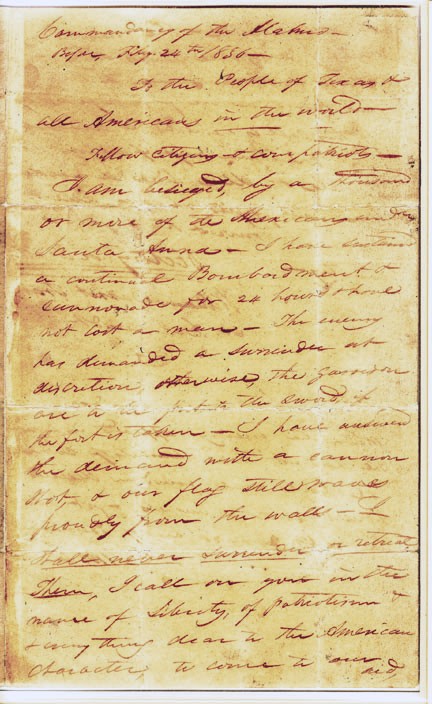
William Barret Travis entered Texas history at extraordinary speed. A lawyer and newspaper publisher who came to Mexican Texas from Alabama, he became involved in resistance to Mexican authority and rose quickly as revolution approached. In February 1836 he took command at the Alamo. Less than two weeks later he was dead at age 26. What survived him was a letter—addressed to the people of Texas and all Americans in the world—that turned the desperate defense in San Antonio into a cause known far beyond the walls of the old mission.
A young lawyer in Mexican Texas
Travis was born in South Carolina in 1809 and grew up in Alabama. He studied law, married young and briefly published a newspaper before leaving for Texas in 1831. He established a legal practice at Anahuac, an area where tensions between settlers and Mexican customs authorities repeatedly flared. Travis participated in the Anahuac disturbances, experiences that established his reputation as one of the more confrontational members of the Anglo-Texan opposition.
Command at the Alamo
By early 1836, Travis had been commissioned a lieutenant colonel in the regular Texian army. He arrived at the Alamo with a small cavalry detachment and soon shared authority uneasily with James Bowie, who represented the volunteer force. When Bowie became seriously ill, Travis assumed full command. The defenders faced a much larger Mexican army led by President-General Antonio López de Santa Anna and had no reliable way to know whether meaningful reinforcement would arrive.
Victory or Death
On February 24, Travis wrote his famous appeal beginning with an address to fellow citizens and compatriots and ending with the pledge 'Victory or Death.' The letter asked for aid but also declared his intention to hold the position. Couriers carried copies out of the besieged fort, and newspapers reproduced the text. Today the original is preserved by the Texas State Library and Archives Commission and is one of the most recognizable primary documents of the Texas Revolution.
The line in the sand: legend and evidence
A famous tradition says Travis drew a line in the ground with his sword and asked men willing to remain and die to cross it. The story is deeply embedded in Texas culture, but historians treat it cautiously because the best-known account appeared decades after the battle and rests on uncertain testimony. The siege itself, Travis’s letters and the garrison’s decision to remain are documented. A strong history of the Alamo does not need to present the line story as proven fact in order to understand why it became such a powerful symbol.
Death, memory and the road to San Jacinto
Mexican troops stormed the Alamo before dawn on March 6. Travis was killed early in the final assault, and the garrison was overwhelmed. News of the loss traveled across Texas during the Runaway Scrape, while the phrase 'Remember the Alamo' became associated with the revolutionary cause before Sam Houston’s victory at San Jacinto. Travis’s place in that memory rests as much on his written words as on his battlefield command.
How to explore the Travis story today
The Alamo in San Antonio is the obvious starting point, but visitors can broaden the story through the San Antonio Missions, archival exhibits, Washington-on-the-Brazos and San Jacinto. Reading Travis alongside James Bowie, Davy Crockett and Tejano leader Juan Seguín also prevents the battle from becoming a one-man story. The result is a more complete view of how military necessity, politics, migration and memory converged in 1836.
Sources and further reading
- Texas State Library and Archives Commission — Travis Letter: https://www.tsl.texas.gov/travis-letter
- The Alamo — William Barret Travis: https://www.thealamo.org/remember/battle-and-revolution/defenders/william-barret-travis
- Handbook of Texas — William Barret Travis: https://www.tshaonline.org/handbook/entries/travis-william-barret
Image credit: Public domain · William Barret Travis / Texas State Library and Archives Commission via Wikimedia Commons
Primary source: Texas State Library and Archives Commission ↗
Filed under
- William B. Travis
- Alamo
- Texas Revolution
- Victory or Death
- San Antonio
From the magazine
More stories to read next
Then & Now
Texas National Cemeteries: Fort Sam Houston, Houston and Dallas–Fort Worth
August 21, 2026 · About 12 minutes
Then & Now
Texas Military Museums & Historic Sites: The Best Places to See the Story in Person
August 20, 2026 · About 19 minutes

.jpg%3Fwidth%3D1600)