texas history
Republic of Texas Government Trail: San Felipe, Washington, Columbia and Austin
Follow Texas government from Austin's colonial capital and the provisional government through the independence convention, the Republic's first Congress, international diplomacy and the final years before statehood.
The Republic of Texas is often told as a sequence of battles followed by a flag and nine years of independence. Government history makes the period look different. Before Texas could function as an independent nation, people had to decide where officials would meet, how records would move, where Congress would sit, how diplomacy would work and what happened when a capital city became unsafe or politically inconvenient.
That is why there is no single Republic of Texas capital story. The governmental center moved repeatedly, and several places held different kinds of authority at different moments. San Felipe de Austin was a colonial and provisional capital. Washington-on-the-Brazos created the independent government and later served again as a capital. Columbia hosted the first Congress and the first presidential inauguration. Houston and Austin followed. The French Legation preserves the international side of the Austin years, while Barrington connects the story to Anson Jones and annexation.
Start at San Felipe: government before independence
Stephen F. Austin founded San Felipe de Austin in 1823 as the capital of his colony on the Brazos. The town became an administrative center where land business, courts, newspapers, merchants and political organizing converged. By the mid-1830s it was one of the most important communities in Mexican Texas.
San Felipe's governmental role intensified during the crisis with Mexico. The Consultation of 1835 met there, and the provisional government operated from the town until the Convention of 1836 assembled at Washington-on-the-Brazos. This distinction matters: San Felipe was not yet the capital of an independent republic, but it was the working political center from which the rebellion tried to govern before formal independence.
The town was evacuated and burned during the Runaway Scrape in March 1836. That destruction helps explain why the new Republic did not simply return its government to San Felipe after San Jacinto. A political center can disappear surprisingly quickly when buildings, records, roads and security all become unstable at once.
Washington-on-the-Brazos: declaring independence and building a government
Delegates gathered at Washington-on-the-Brazos in March 1836 while the military situation was deteriorating. They declared independence, drafted a constitution and established an interim government. The work was not ceremonial. A declaration without institutions would not have created a functioning nation.
The Washington townsite is especially useful because the scale remains comprehensible. Visitors can move between the Independence Hall interpretation, the Star of the Republic Museum and the surrounding Brazos landscape rather than imagining the founding of the Republic as something that happened in a monumental capital complex.
Washington later returned to the center of government. During renewed tensions with Mexico in 1842, President Sam Houston moved the capital away from Austin, and Washington served as the Republic capital again until the government returned to Austin in 1845. The same town therefore belongs to both the Republic's birth and its later political life.
Columbia: the first Congress and Sam Houston's inauguration
After independence, the new government moved to Columbia, now West Columbia. The first Congress of the Republic met there in 1836. Sam Houston took office as president, and Stephen F. Austin became secretary of state. For a brief period this Brazoria County community carried the practical weight of a national capital.
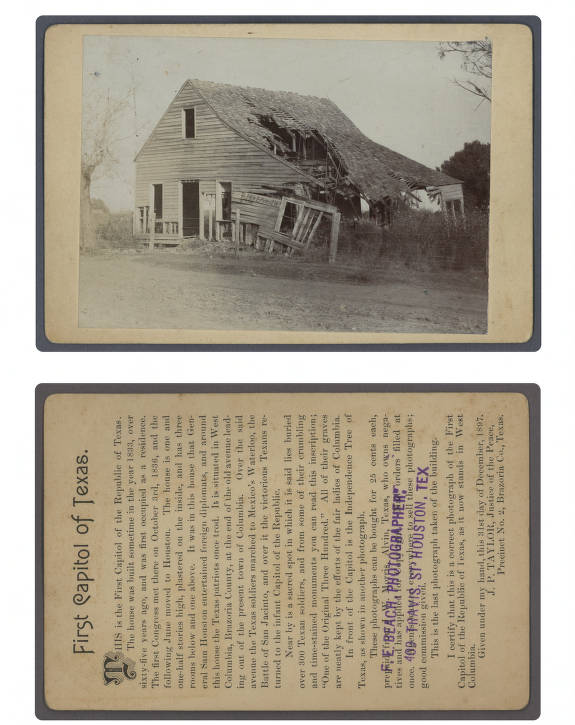
The First Capitol of Texas State Historic Site marks that chapter. The original governmental buildings did not survive, which makes the site less visually obvious than a preserved courthouse or capitol. Its value is the location and the political sequence: the Republic moved rapidly from a wartime convention government into a constitutional administration that needed Congress, executive offices and records.
This is also the right place to connect Stephen F. Austin's final chapter. Austin's appointment as secretary of state tied him directly to the new administration, but his service was brief. The nearby Stephen F. Austin Memorial brings the colony founder's story to its end in Brazoria County only months after independence.
Why the capital kept moving
The Republic's capitals changed for a mixture of practical and political reasons. Buildings had to exist. Officials needed roads, lodging, printing, records and communications. Military threats mattered. So did land speculation, regional rivalry and the desire to shift the center of political power.
Houston became the capital in 1837, and the government later moved to the new city of Austin. The move westward was part of a larger argument about the Republic's future geography. Austin placed the capital closer to the frontier than earlier Brazos and Gulf-oriented centers, making the seat of government itself a statement about expansion.
The capital question was not permanently settled. When Mexican forces threatened San Antonio in 1842, Sam Houston ordered government archives removed from Austin, creating the episode remembered as the Archive War. The government operated from Washington-on-the-Brazos for part of the Republic's final years before returning to Austin.
Austin and the French Legation: government becomes diplomacy
The French Legation adds a dimension that the earlier capital sites cannot. France recognized the Republic of Texas as a sovereign nation, and the Austin property opened in 1841 as the home and diplomatic outpost of the French chargé d'affaires. The surviving house turns international recognition into a physical place.
That matters because independence was not only a domestic political claim. The Republic needed foreign recognition, commercial relationships and diplomatic channels. A legation in the capital demonstrates that Texas was trying to function as a nation within an international system, not merely operate a temporary local government.
The house also shows how small the capital still was. Modern Austin can make Republic-era diplomacy feel abstract, but the French Legation survives at neighborhood scale. Government, diplomacy and settlement growth were happening almost on top of one another.
Barrington and Anson Jones: how an independent republic ended
Barrington Living History Farm preserves the final home of Anson Jones, the last president of the Republic. It belongs on this route because the capital story should not stop when Austin becomes the seat of government. The Republic ended through annexation, and Jones was the president who oversaw that transition.
On February 19, 1846, the transfer to U.S. state government formally ended the Republic of Texas. Visiting Barrington after the governmental sites changes the emphasis from founding to transition: the independent nation had created institutions, capitals and foreign relationships, then chose a different political future inside the United States.
How to travel the government trail
The sites divide naturally into three regional trips rather than one exhausting drive across the state.
- Brazos founding day: San Felipe de Austin, then Washington-on-the-Brazos and the Star of the Republic Museum.
- Brazoria County government day: First Capitol of Texas in West Columbia, Stephen F. Austin Memorial and nearby Republic-era context.
- Austin diplomacy day: French Legation, then the modern Capitol area to compare the Republic-era capital with the later state-government city.
- Washington County extension: Barrington Living History Farm for Anson Jones, domestic life and the end of the Republic.
What this route changes about the Republic story
Following government rather than battles reveals a Republic that was constantly improvising. Officials worked in small settlements, relocated records, argued over capital sites, built new institutions and sought recognition abroad. The repeated moves were not trivia; they show how fragile and unfinished the new nation remained.
San Felipe explains the political machinery that existed before independence. Washington explains how a rebellion attempted to become a government. Columbia shows the first constitutional administration taking office. Austin and the French Legation show a capital trying to behave like the seat of an internationally recognized nation. Barrington and Anson Jones close the loop with annexation.
Together, those places make the Republic of Texas easier to understand as a government rather than a symbol. The history becomes less about one famous building and more about the difficult work of creating, moving and eventually dissolving the institutions of an independent country.
Image credit: F. E. Beach / DeGolyer Library, SMU · no known copyright restrictions · Wikimedia Commons
Primary source: Texas Historical Commission ↗
Filed under
- republic of texas
- texas capitals
- san felipe de austin
- washington on the brazos
- west columbia texas
- french legation
- texas government history
- sam houston
Plan the trip
Places connected to this story
Destinations explicitly tied to this article in the Texas Defined guide.
San Felipe · Austin County
San Felipe de Austin State Historic Site
Stephen F. Austin established his colonial headquarters here in 1823, making San Felipe a political and commercial center of Mexican Texas and the revolutionary period. The museum and townsite are foundational for understanding Austin's colony, immigration and the political road to the Texas Revolution.
Best season: Year-round; spring and fall are usually the most comfortable for outdoor portions of a visit.Updated Aug 2026- Stephen F. Austin
- Mexican Texas
- Texas Revolution
Washington · Washington County
Star of the Republic Museum
The museum interprets the Republic of Texas and the Washington-on-the-Brazos landscape where delegates declared independence in 1836. It provides the artifact-rich museum component of a larger Washington-on-the-Brazos visit and works especially well with Barrington Living History Farm.
Best season: Year-round; spring and fall are usually the most comfortable for outdoor portions of a visit.Updated Aug 2026- Republic of Texas
- Texas independence
- Washington-on-the-Brazos
West Columbia · Brazoria County
First Capitol of Texas
Columbia served as the first capital of the Republic of Texas, where Sam Houston was inaugurated as president in October 1836. The site anchors a Brazoria County route through the earliest months of the Republic and Stephen F. Austin's final chapter.
Best season: Year-round; spring and fall are usually the most comfortable for outdoor portions of a visit.Updated Aug 2026- Republic of Texas
- Sam Houston
- early state capitals
West Columbia · Brazoria County
Stephen F. Austin Memorial
The memorial marks the place associated with the home where Stephen F. Austin died in December 1836, only months after Texas won independence. Combine it with the First Capitol and nearby Brazoria County sites to follow Austin's colony from its beginnings through the Republic's first year.
Best season: Year-round; spring and fall are usually the most comfortable for outdoor portions of a visit.Updated Aug 2026- Stephen F. Austin
- Republic of Texas
- Brazoria County
Austin · Travis County
French Legation State Historic Site
One of Austin's oldest surviving residences began as a diplomatic property tied to France's recognition of the Republic of Texas. The house brings international diplomacy down to neighborhood scale and offers a striking counterpoint to the nearby Capitol complex.
Best season: Year-round; spring and fall are usually the most comfortable for outdoor portions of a visit.Updated Aug 2026- Republic diplomacy
- Austin history
- historic architecture
Washington · Washington County
Barrington Living History Farm
The farm interprets the home and working world of Anson Jones, the last president of the Republic of Texas. Living-history demonstrations turn Republic-era agriculture, labor and domestic life into something visitors can see rather than only read about.
Best season: Year-round; spring and fall are usually the most comfortable for outdoor portions of a visit.Updated Aug 2026- Republic of Texas
- Anson Jones
- living history


From the magazine
More stories to read next
Then & Now
Texas National Cemeteries: Fort Sam Houston, Houston and Dallas–Fort Worth
August 21, 2026 · About 12 minutes
Then & Now
Texas Military Museums & Historic Sites: The Best Places to See the Story in Person
August 20, 2026 · About 19 minutes

.jpg%3Fwidth%3D1600)