texas history
Texas Oil Boom: Wichita Falls, West Texas and the Rigs That Changed the State
Wichita Falls and the Permian Basin belong to different oil regions, but together they show how drilling transformed Texas cities, landscapes, jobs and politics.
Oil rigs are among the most recognizable symbols of modern Texas, but the state’s petroleum story is not one single boom. Spindletop near Beaumont transformed the industry on the Gulf Coast in 1901. North Texas fields helped make Wichita Falls an oil center during the 1910s and 1920s. Farther west, discoveries in the Permian Basin eventually created one of the world’s great petroleum-producing regions. Putting Wichita Falls and West Texas together is useful only if we keep the geography straight: they are distinct chapters in a statewide energy transformation.
Spindletop changes the scale of Texas oil
Texas had oil production before 1901, but the Lucas gusher at Spindletop near Beaumont demonstrated production on a scale that attracted major capital and created new companies almost overnight. Refineries, pipelines and Gulf Coast ports grew with the industry. The boom helped establish petroleum as a force capable of reshaping the state’s economy rather than a specialized local business.
Wichita Falls and the North Texas boom
Oil discoveries around Electra, Burkburnett and other North Texas communities transformed Wichita Falls into a regional financial and service center. The Burkburnett boom after 1918 became especially famous, drawing workers, speculators and equipment into a suddenly crowded field. Wichita Falls benefited from banking, transportation, supply and professional services that supported drilling across the region.
West Texas and the Permian Basin
The Permian Basin is a different geological and economic story centered much farther west, around cities including Midland and Odessa and stretching into southeastern New Mexico. Important discoveries in the 1920s and later development turned the basin into a dominant production region. Advances in horizontal drilling and hydraulic fracturing created another surge in the twenty-first century, making pumpjacks, drilling rigs and flare stacks defining features of parts of the West Texas landscape.
Boomtown wealth—and boomtown strain
Oil booms bring jobs, tax revenue and investment, but they also strain housing, roads, schools, hospitals and local government. Prices and employment can rise quickly and fall when commodity markets turn. Cities such as Midland and Odessa have lived through repeated cycles. Earlier boomtowns faced similar patterns, even if the technology and scale were different. The Texas oil story is therefore as much about volatility as wealth.
The industry changes Texas politics and infrastructure
Petroleum wealth funded companies, philanthropy, universities and fortunes while creating a powerful industry with a major voice in state and national policy. Pipelines and refineries tied inland fields to the Gulf Coast. The Texas Railroad Commission became a central regulator of production long after railroads stopped being its most famous responsibility. Energy shaped population growth and helped turn Texas into an industrial and urban state.
Seeing the oil story on a Texas road trip
Travelers can encounter different pieces of this history at Spindletop-Gladys City near Beaumont, the Permian Basin Petroleum Museum in Midland, and museums and historic sites around Wichita Falls and Burkburnett. The distances between them are a feature, not a flaw: they show that 'Texas oil country' is not one place. It is a network of fields, towns, refineries, ports and landscapes that developed across more than a century.
Why this story still matters
Texas oil history is not one boom in one place, and separating North Texas from the Permian Basin makes the statewide story clearer. The Handbook of Texas documents the development of the oil and gas industry and the importance of early producing regions, while Railroad Commission material defines the Permian Basin as a major West Texas producing system with its own geology and regulatory context. Wichita Falls and surrounding North Texas fields belong to an earlier geography of drilling, investment, rail connections, and fast-growing oil towns; the Permian story reflects a different scale and a much longer cycle of technological change. Putting the regions together shows how petroleum repeatedly reorganized Texas communities without doing so in exactly the same way. It shaped jobs, infrastructure, land values, migration, public revenue, and environmental questions, while the visible landscape of derricks, pumpjacks, service roads, and industrial towns became part of how outsiders imagine Texas.
Sources and further reading
- Handbook of Texas — Oil and Gas Industry: https://www.tshaonline.org/handbook/entries/oil-and-gas-industry
- Railroad Commission of Texas — Permian Basin: https://www.rrc.texas.gov/oil-and-gas/major-oil-and-gas-formations/permian-basin/
- Handbook of Texas — Permian Basin: https://www.tshaonline.org/handbook/entries/permian-basin
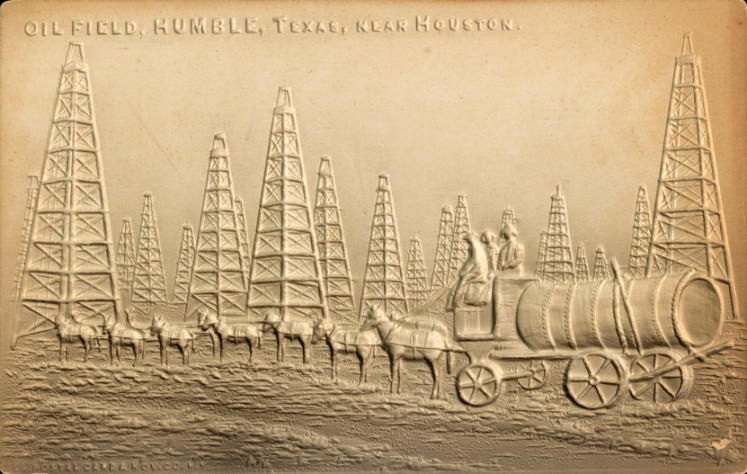
Image credit: Courtesy of Special Collections, University of Houston Libraries · Public domain · Wikimedia Commons
Primary source: Texas State Historical Association ↗
Filed under
- Texas oil history
- Wichita Falls
- Permian Basin
- West Texas oil
- Texas energy
From the magazine
More stories to read next
Then & Now
Texas National Cemeteries: Fort Sam Houston, Houston and Dallas–Fort Worth
August 21, 2026 · About 12 minutes
Then & Now
Texas Military Museums & Historic Sites: The Best Places to See the Story in Person
August 20, 2026 · About 19 minutes

.jpg%3Fwidth%3D1600)