
texas history
Presidential Texas: Historic Homes of Eisenhower, Bush and Sam Rayburn
Three modest Texas homes reveal how national political careers grew from railroad towns, oil-boom neighborhoods and rural North Texas rather than monumental settings.
Political history often gets displayed at the scale of capitols, libraries and monuments. Texas has those places, but some of its most revealing political sites are ordinary houses. A small railroad-town birthplace in Denison, a postwar family home in Midland and a rural North Texas house near Bonham tell very different stories about how national power can grow out of local places.
This is not a route that claims the houses 'made' the people associated with them. Dwight D. Eisenhower left Texas as a child. George H. W. Bush and George W. Bush built careers that stretched far beyond Midland. Sam Rayburn spent decades in Washington. The point is different: historic homes preserve the domestic scale that political biographies often lose.
Why these homes belong together
The three sites span different eras and different versions of Texas. Eisenhower's birthplace belongs to the railroad economy of late-nineteenth-century Denison. The Bush Family Home sits inside the postwar petroleum growth of Midland. The Sam Rayburn House reflects a politician whose national influence remained tied to a deliberately modest rural home base.
Together they make a useful triangle of American political history: military leadership and the presidency, a modern political family shaped in the Permian Basin, and congressional power exercised by one of the longest-serving Speakers of the House.
Eisenhower Birthplace: a railroad town before a presidential story
Dwight David Eisenhower was born in Denison in 1890. His family did not remain there long, which means the site's historical value is not a story of a president growing up in one Texas neighborhood for decades. Instead, it captures a brief family chapter inside a booming railroad town.
That local context matters. Denison developed around transportation, commerce and the arrival of rail connections that transformed North Texas towns in the late nineteenth century. The modest birthplace makes more sense when visitors look beyond the future general and president to the city that existed around his family.
The house is intentionally small in scale. That is useful. Eisenhower's later career included Supreme Allied Command in Europe during World War II and two terms as president, but the birthplace strips away the institutional grandeur. The contrast between one room, one household and later global responsibility is the site's strongest interpretive tool.
How to build a Denison day around the birthplace
Pair the home with downtown Denison so the visit retains its railroad-town context. Lake Texoma can provide the second half of the day, especially for families who want to alternate a compact historic-home visit with outdoor time. Eisenhower State Park also preserves the president's name in a very different type of public landscape.
The best question to carry through the site is not 'What presidential decisions happened here?' None did. Ask instead what this house says about mobility, work and family life in a late-nineteenth-century railroad community—and why Americans choose to preserve the earliest places associated with later national figures.
Bush Family Home: presidential history inside the Permian Basin boom
The Bush Family Home in Midland belongs to a very different Texas. The postwar Permian Basin was a region of rapid population growth, oil development, entrepreneurial risk and suburban expansion. George H. W. Bush moved his young family to West Texas as he entered the oil business, and the Midland home places a nationally prominent political family inside that regional transformation.
This is one reason the house should be visited as a Midland site rather than a detached presidential shrine. The neighborhood, city and oil economy explain why the family was there. Midland was not background scenery. It was part of a broader Sun Belt story in which energy, population and political influence shifted toward fast-growing western and southern metropolitan areas.
The domestic setting also keeps multiple generations visible. George W. Bush's childhood connection to Midland gives the home an unusual relationship to two presidencies, but the site's value is broader than presidential trivia. It is a family-history lens on postwar West Texas.
Make Midland part of the interpretation
A useful Midland itinerary pairs the home with a museum or attraction that explains petroleum, geology or regional development. That turns the question from 'Which famous person slept here?' into 'Why were so many ambitious families moving to places like Midland at this moment in American history?'
The city's modern skyline, oil industry and sprawling metropolitan form create a productive contrast with the preserved residential house. The more visitors understand the Permian Basin, the less isolated the Bush story becomes.
Sam Rayburn House: congressional power with a rural home base
Sam Rayburn never became president, but leaving him out of a Texas political-homes route would misunderstand how power works in the United States. Rayburn represented North Texas in Congress for decades and became one of the most consequential Speakers of the U.S. House.
His home near Bonham is compelling because it does not perform political grandeur. The setting emphasizes personal routine, family, agricultural land and a North Texas identity that remained important even as Rayburn operated at the center of national legislation and party leadership.
For visitors accustomed to presidential libraries and monumental memorials, the Rayburn house makes a different argument: enormous institutional influence can coexist with a home that remains intentionally local and familiar.
Bonham and Fannin County complete the stop
Use Bonham as more than a service stop. The courthouse community, local history and surrounding agricultural landscape help explain the political constituency Rayburn represented. His career makes more sense when the district is visible as a place rather than an abstract shape on an election map.
This is also a good route for thinking about how transportation changed political life. Eisenhower's birthplace belongs to a railroad town. Midland's Bush story belongs to the aviation, highway and petroleum age. Rayburn's connection to rural North Texas spans a period when roads, electrification and federal policy transformed agricultural communities.
Add Casa Navarro for a longer view of Texas political history
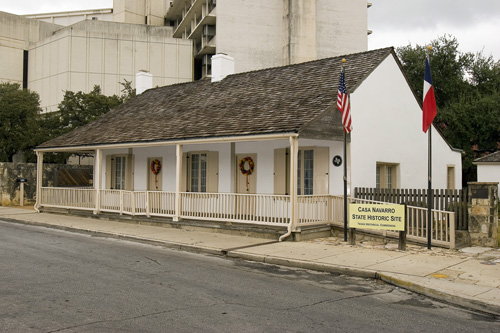
A statewide political-history trip should not imply that Texas public life begins with twentieth-century presidents and congressional leaders. Casa Navarro in San Antonio adds José Antonio Navarro, a Tejano statesman whose career connects Mexican Texas, the Texas Revolution, the Republic and statehood.
That extension changes the chronology and the cultural frame. Navarro's home makes it harder to tell Texas political development as a simple line from Anglo settlement to modern national office. Tejano political leadership was central to the state's formation, and San Antonio's older history predates every site on the presidential triangle by generations.
What historic homes can show that biographies cannot
Biographies tend to organize lives around achievements: elections won, offices held, battles commanded, bills passed. Houses preserve different evidence. Room size, neighborhood location, household technology, family objects and distance from a city center can reveal the ordinary environment around a public figure.
That evidence needs interpretation. A preserved home is not neutral simply because the furniture looks authentic. Choices about which rooms to show, whose memories to emphasize and what later visitors are asked to admire shape the story. The strongest visits are the ones that connect domestic life to the larger economic and social history outside the front door.
A practical three-region itinerary
- North Texas: Eisenhower Birthplace in Denison, with downtown railroad context and optional Lake Texoma time.
- West Texas: Bush Family Home in Midland, paired with petroleum and Permian Basin history.
- Northeast Texas: Sam Rayburn House near Bonham, with the county-seat and agricultural landscape as context.
- San Antonio extension: Casa Navarro for a nineteenth-century Tejano political history that broadens the route beyond modern national office.
Planning notes
- Historic-home hours can be narrower than large museum schedules, so check the official site before traveling.
- Guided tours often provide more value than a fast self-guided walk because domestic objects need context.
- Pair each house with the surrounding city or landscape; the local economy explains why the family lived there.
- Avoid treating homes as proof of inevitable greatness. They are evidence of one chapter in a much longer life.
- Use the route to compare eras: railroad Texas, rural congressional Texas, postwar oil-boom Texas and the older Tejano political world of San Antonio.
The route works because the houses are modest. Monumental buildings tell visitors that someone became important. These homes ask a more interesting question: what did Texas look like around people before, during and between the public roles that later made their names national?
Image credit: E's & D's Adventures in Life · CC BY 2.0 · Wikimedia Commons
Primary source: Texas Historical Commission ↗
Filed under
- texas presidents
- eisenhower birthplace
- bush family home
- sam rayburn house
- texas political history
- historic homes
Plan the trip
Places connected to this story
Destinations explicitly tied to this article in the Texas Defined guide.
Denison · Grayson County
Eisenhower Birthplace State Historic Site
Dwight D. Eisenhower, Supreme Allied Commander in Europe during World War II and the 34th U.S. president, was born in Denison in 1890. The modest birthplace provides a Texas starting point for a life that became central to both global military history and the American presidency.
Best season: Year-round; spring and fall are usually the most comfortable for outdoor portions of a visit.Updated Aug 2026- Dwight Eisenhower
- presidential history
- World War II
Midland · Midland County
Bush Family Home State Historic Site
The Midland home preserves the West Texas years of a family that would produce presidents, governors, a vice president and two first and second ladies. The house gives presidential history a domestic West Texas setting and helps explain how Midland's postwar boom shaped the Bush family's early years.
Best season: Year-round; spring and fall are usually the most comfortable for outdoor portions of a visit.Updated Aug 2026- presidential history
- Midland
- 20th-century Texas
Bonham · Fannin County
Sam Rayburn House State Historic Site
The home preserves the private world of Sam Rayburn, the longtime U.S. House speaker and one of the most influential Texans in 20th-century national politics. The contrast between Rayburn's national power and his relatively modest North Texas home is the site's most revealing story.
Best season: Year-round; spring and fall are usually the most comfortable for outdoor portions of a visit.Updated Aug 2026- Sam Rayburn
- Congressional history
- historic homes
San Antonio · Bexar County
Casa Navarro State Historic Site
The restored home and property interpret the life of José Antonio Navarro, a Tejano statesman, signer of the Texas Declaration of Independence and influential early Texas leader. Casa Navarro adds an indispensable Tejano perspective to a San Antonio history itinerary that can otherwise lean too heavily on military sites alone.
Best season: Year-round; spring and fall are usually the most comfortable for outdoor portions of a visit.Updated Aug 2026- Tejano history
- José Antonio Navarro
- San Antonio


From the magazine
More stories to read next
Then & Now
Texas National Cemeteries: Fort Sam Houston, Houston and Dallas–Fort Worth
August 21, 2026 · About 12 minutes
Then & Now
Texas Military Museums & Historic Sites: The Best Places to See the Story in Person
August 20, 2026 · About 19 minutes

.jpg%3Fwidth%3D1600)